
- The challenge emerges when onboarding, payments, servicing, identity, and compliance operate as separate systems.
- In Africa, financial engagement scales when identity, payments, distribution, and servicing are designed around real customer constraints.
- Physical and digital channels are increasingly connected in the EU and UK, allowing customers to move seamlessly between self-service and human support.
It doesn’t seem that long ago when banks were weighing up whether the future was digital or physical. The pandemic helped to accelerate that shift, as millions of people worldwide switched to mobile and online banking during lockdowns, a habit that has continued amid a decline in physical branches. Today, however, banks are facing a new challenge: delivering trust, speed, and control through a coherent customer journey across markets as different as Africa, Europe, and the UK.
The challenges vary between markets. In Africa, for instance, they include reach, affordability, interoperability, and controlled scale. The approach varies between mobile-money ecosystems, bank-led markets, and regional frameworks such as the West African Economic and Monetary Union (WAEMU) and Central African Economic and Monetary Community (CEMAC).
In Europe and the UK, it is about simplifying journeys across legacy-heavy estates without weakening resilience, compliance, or service quality. The strategic issue is architectural, not cosmetic. The challenge emerges when onboarding, payments, servicing, identity, and compliance operate as separate systems with distinct trade-offs. The institutions that win will be those that can combine these capabilities without redesigning every journey from scratch.
Africa: Where mobile-first ecosystems dominate
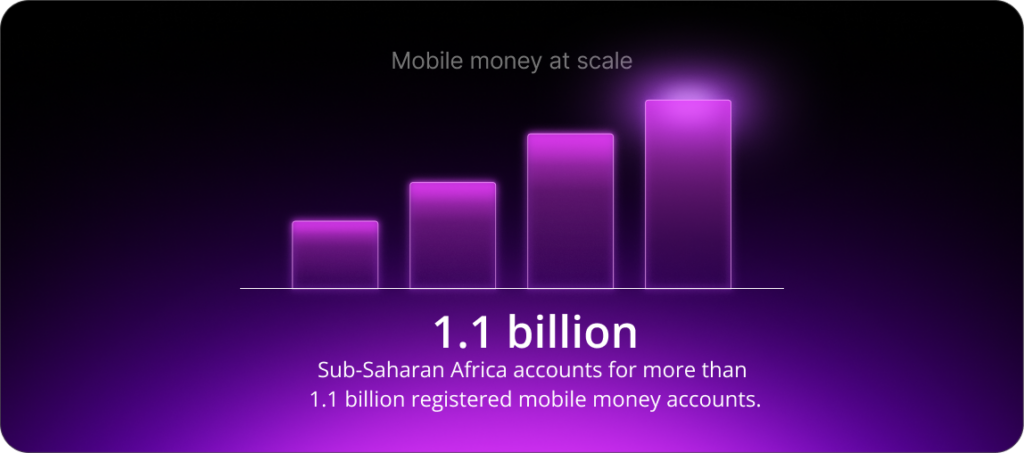
Sub-Saharan Africa is the world’s leading mobile-money region, where digital financial services have been designed to be mobile-first, agent-supported, and built for reach. A 2025 report by the GSMA noted that Sub-Saharan Africa accounted for more than 1.1 billion registered mobile money accounts, and global mobile money transaction value exceeded $1.68 trillion.
In several markets, mobile money now functions as infrastructure rather than an adjacent digital channel. M-Pesa, a mobile-money platform available in eight countries in Africa, shows what happens when a payment rail becomes an ecosystem. MTN MoMo also shows the power of telecom distribution. In 2024, MTN reported 291 million subscribers and 63.1 million active MoMo users across 16 countries, highlighting that reach and financial-services usage are different metrics.
These models demonstrate that high-frequency payment use cases create distribution power, which then expands into savings, credit, and merchant services. But the lesson is not “build a super app.” It is that financial engagement scales when identity, payments, distribution, and servicing are designed around customer constraints.
Why digital identity is not a shortcut
Digital identity is becoming an enabler of financial inclusion across African markets, but its effect is uneven. When national identity systems, banking identifiers, and eKYC processes connect, onboarding friction drops. While identity can still narrow the gap if they don’t connect, it is not a complete solution.
In Nigeria, tiered and risk-based KYC can widen access, but only when combined with identity infrastructure, transaction limits, monitoring, and supervisory control.
Another example is Ethiopia’s Fayda program. The national digital ID has registered more than 45 million people and supported nearly 90 million eKYC transactions, proving that digital identity can become a foundation for broader financial inclusion.
Digital identity can reduce onboarding friction when local regulations, assurance levels, and bank risk policies allow it. However, it does not remove the need for anti-money laundering controls, product-level risk decisions, sanctions screening, transaction monitoring, or human fallbacks.
Europe: Hybrid digital banking models
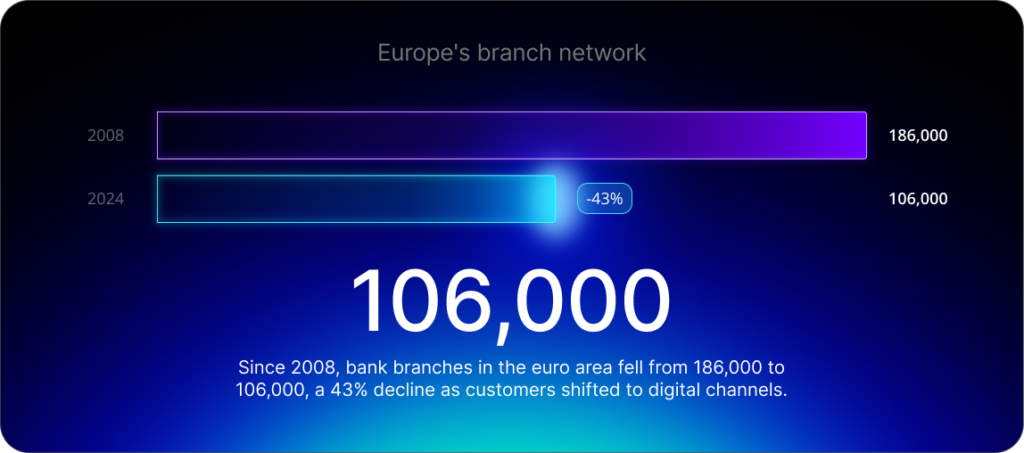
European banking is rebalancing between physical and digital channels. Since 2008, the number of bank branches in the euro area has fallen from around 186,000 to 106,000, reflecting the shift toward digital-first interactions.
However, customers continue to value physical access for advice, complex financial decisions, and reassurance. In France, a 2024 survey found that 80% of customers prefer a bank that offers both digital and in-branch services. Meanwhile, 83% report using a mix of channels, from websites and email to phone and branch, as part of their banking journey. This creates an operating dilemma: how to reduce the cost of physical networks without losing the trust, reassurance, and support they provide.
This has led to the emergence of hybrid banking models. Rather than operating as standalone touchpoints, physical and digital channels are increasingly connected, allowing customers to move seamlessly between self-service and human support.
Regulation is changing architecture, not just compliance
Europe’s challenge is the need to simplify customer journeys while absorbing a regulatory and operational load that is more interconnected than most other regions. While regulation is no longer a downstream compliance exercise, it is shaping how banks design identity, payments, servicing, resilience, and data flows.
Instant euro payments require 24/7 execution, verification of payee, and stronger fraud controls. The EU Digital Identity Wallet framework will require member states to provide at least one wallet by 2026, with implications for onboarding, authentication, and credential sharing. Meanwhile, the Authority for Anti-Money Laundering and Countering the Financing of Terrorism (AMLA) began operations in July 2025, reinforcing the shift toward more harmonized and more data-driven AML expectations across the EU.
This has resulted in banks moving beyond a periodic KYC refresh to continuous customer risk monitoring. Another implication is the maturation of open banking in the UK, where Open Banking Limited reported 13.3 million active users as of March 2025. The most likely next failure mode in digital banking is fragmented journeys: one logic for onboarding, another for payments, another for servicing and another for compliance, with no coherent customer outcome.
Across markets in Africa, Europe, and the UK, the operational failure is increasingly the same, where identity, payments, servicing, compliance, and human support are still managed as separate transformation streams. The banks that matter over the next cycle will not be those with the most screens. They will be the ones that can deliver one controlled, auditable, and adaptable journey across products, channels, and regulatory contexts.
Read the full report here.
Q&A: Key questions on the coherent customer journey
A major challenge faced by banks is delivering trust, speed, and control through a coherent customer journey across markets as different as Africa, Europe, and the UK. Research shows that the likely next failure mode in digital banking is not a lack of channels. Instead, it is fragmented journeys with no coherent customer outcome.
