
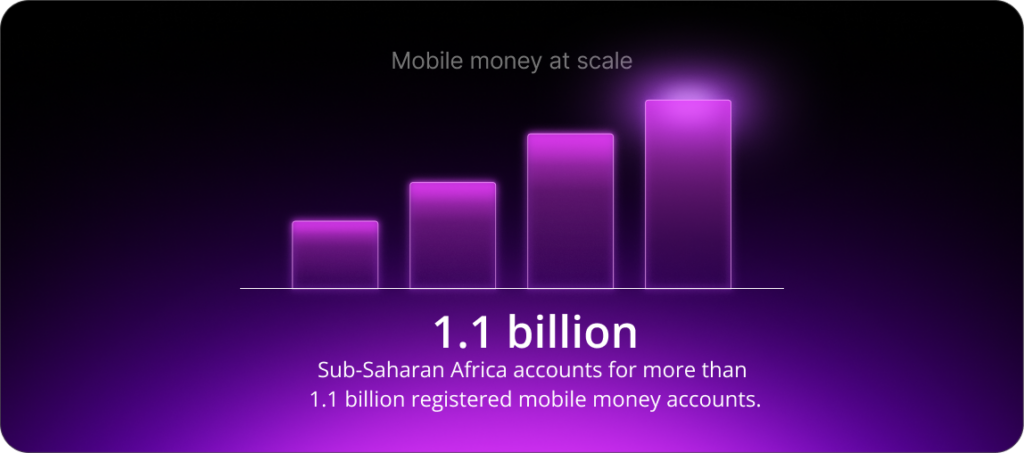
- Sub-Saharan Africa accounts for more than 1.1 billion registered mobile money accounts.
- Global mobile money transaction value exceeded $1.68 trillion in 2024.
- MTN reported 291 million subscribers and 63.1 million active MoMo users in 2024.
The useful question in digital banking is no longer who is ahead, or whether the future is digital or physical. It is whether a bank can deliver trust, speed and control through a coherent customer journey across markets as different as Africa, the Gulf Cooperation Council (GCC), Europe and the UK.
The pressures differ. In African markets, the challenge is often reach, affordability, interoperability and controlled scale, though the model varies between mobile-money-led ecosystems, bank-led markets and regional frameworks such as West African Economic and Monetary Union (WAEMU) and Central African Economic and Monetary Community (CEMAC). In the GCC, it is regulator-led modernization at speed. In Europe and the UK, it is simplifying journeys across legacy-heavy estates without weakening resilience, compliance or service quality.
The strategic issue is architectural, not cosmetic. Banks do not lose ground because they lack channels. The challenge emerges when onboarding, payments, servicing, identity and compliance operate as separate systems with separate trade-offs. The institutions that win will be those that can orchestrate these capabilities without redesigning every journey from scratch.
Africa
Mobile-first ecosystems
Sub-Saharan Africa is the world’s leading mobile-money region, and that matters because it has shaped digital financial services that are mobile-first, agent-supported and built for reach. The lesson is not that Africa offers one model, but that many markets were forced to solve for accessibility, distribution and cost discipline before product depth.
According to the GSMA, Sub-Saharan Africa accounts for more than 1.1 billion registered mobile money accounts, and global mobile money transaction value exceeded $1.68 trillion in 2024. In several markets, mobile money now functions as infrastructure, not simply as an adjacent digital channel.
That distinction matters. M-Pesa demonstrates what happens when a payment rail becomes an ecosystem. MTN MoMo, meanwhile, shows the power of telecom distribution: MTN reported 291 million subscribers and 63.1 million active MoMo users in 2024, underscoring that reach and financial-services usage are not the same metric.
Across these models, the pattern is clear: high-frequency payment use cases create distribution power, and distribution power can then expand into savings, credit and merchant services. But the durable lesson is not “build a super app.” It is that financial engagement scales when identity, payments, distribution and servicing are designed around real customer constraints.
Digital identity as an onboarding enabler, not a shortcut
Digital identity is becoming a meaningful enabler of inclusion across African markets, but its effect is uneven. Where national identity systems, banking identifiers and electronic Know Your Customer (eKYC) processes connect well, onboarding friction falls materially. Where they do not, identity remains an enabler rather than a complete solution.
The policy lesson is proportionality. Nigeria shows that tiered and risk-based KYC can widen access, but only when combined with identity infrastructure, transaction limits, monitoring and supervisory control.
Ethiopia’s Fayda program points in the same direction. The national digital ID has registered more than 45 million people and supported nearly 90 million eKYC transactions, illustrating how digital identity can become a foundation for broader financial inclusion.
The broader lesson is straightforward. Digital identity can reduce onboarding friction where local regulation, assurance levels and bank risk policy allow it. It does not remove the need for Anti-Money Laundering (AML) controls, product-level risk decisions, sanctions screening, transaction monitoring or human fallbacks.
Europe
Branch and digital hybrid models
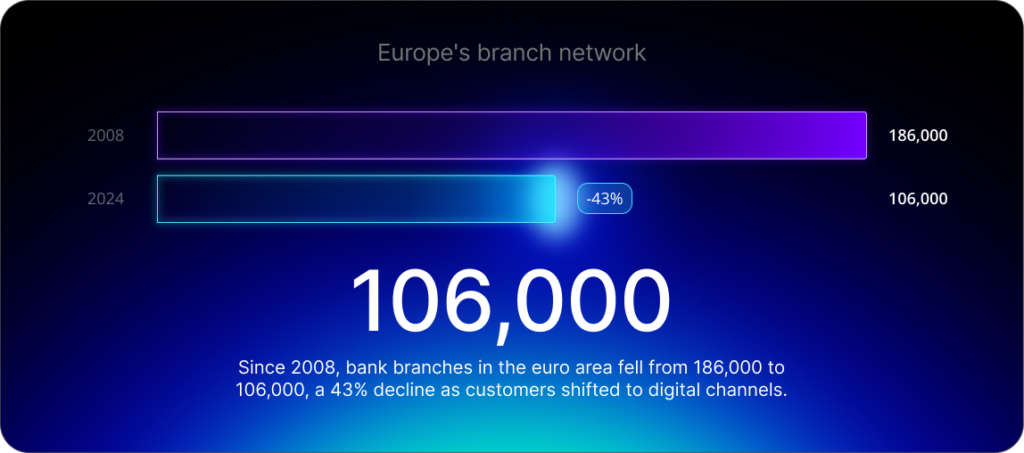
European banking is rebalancing between physical and digital channels. Since 2008, the number of bank branches in the euro area has fallen from around 186,000 to roughly 106,000, reflecting the shift toward digital-first interactions.
Yet the branch is far from obsolete. Customers continue to value physical access for advice, complex financial decisions and reassurance. In France, for example, around 80% of customers say they prefer a bank that offers both digital and in-branch services, while 83% report using a mix of channels from websites and email to phone and branch as part of their banking journey.
This creates a real operating dilemma: how to reduce the cost of physical networks without stripping out the trust, reassurance and support they still provide.
The response has been the emergence of hybrid banking models. In these models, digital channels handle routine interactions, while branches are repositioned as advisory hubs integrated into broader customer journeys. Rather than operating as standalone touchpoints, physical and digital channels are increasingly connected, allowing customers to move seamlessly between self-service and human support.
The strategic conclusion is not that branches are vindicated. It is that human support remains necessary in higher-friction or higher-trust moments, whether delivered through branches, remote advisory, assisted channels or case-managed servicing.
Regulation is changing architecture, not just compliance
Europe’s challenge is not a lack of digital ambition. It is the need to simplify customer journeys while absorbing regulatory and operational load that is both deeper and more interconnected than in most other regions. The practical consequence is that regulation is no longer a downstream compliance exercise. It is shaping how banks design identity, payments, servicing, resilience and data flows from the start.
That agenda is now concrete. Instant euro payments require 24/7 execution, verification of payee and stronger fraud controls. The EU Digital Identity Wallet framework will require member states to provide at least one wallet by 2026, with direct implications for onboarding, authentication and credential sharing. Meanwhile, AMLA took up operations on 1 July 2025, reinforcing the shift toward more harmonized and more data-driven AML expectations across the Union.
One implication is the move beyond purely periodic KYC refresh toward more event-driven and continuous customer risk monitoring. Another is the continued maturation of open banking in the UK, where Open Banking Limited reported 13.3 million active users as of March 2025, equivalent to roughly one in five consumers and small businesses. These are not isolated compliance or innovation stories. They show how identity, consent, risk and payment initiation are becoming part of the operating model itself.
The architectural consequence is clear: banks need more than compliant interfaces. They need customer journeys that can coordinate identity, consent, fraud controls, payment initiation, case management and human escalation without duplicating logic across channels. That is what differentiates institutions that digitize processes from those that redesign operating models.
Three operating models, one architectural challenge
The useful comparison is not which region is ahead. It is what each operating model forces banks to get right. In Africa WAEMU and CEMAC, the pressure is on interoperability, reach and controlled scaling. In the GCC, the pressure is on modernizing quickly around stronger identity, payments and supervisory frameworks. In Europe, the pressure is on simplifying journeys without weakening resilience, control or service quality.
- Africa, including WAEMU and CEMAC. The lesson is not that Africa moves faster. It is that different African markets reveal, in different ways, that reach, assisted distribution, payment-led engagement, interoperability and proportional onboarding are not side issues. They are the operating model. WAEMU and CEMAC make that especially visible through more centralized regional frameworks.
- GCC. The lesson is regulator-led modernization at speed. Where digital adoption is high and payment and identity rails are strengthening, the challenge is no longer whether customers will go digital. It is whether banks can industrialize service quality fast enough to match the infrastructure.
- Europe. The lesson is that control has to be designed into journeys, not layered on afterward. Payments, consent, resilience, AML and servicing are now too interconnected to be handled as separate transformation streams.
The common requirement across all three is orchestration: one journey logic across digital and human touchpoints, and one operating backbone across identity, payments, risk, servicing and compliance.
The point is not convergence. It is execution discipline. Across African markets, the GCC, Europe and the UK, the operational failure is increasingly the same: identity, payments, servicing, compliance and human support are still managed as separate transformation streams. The implication is not to copy another region’s front end, but to build an engagement architecture that can absorb different regulatory rails, identity models, payment infrastructures and service expectations without rebuilding each journey market by market.
The most likely next failure mode in digital banking is not a lack of channels. It is fragmented journeys: one logic for onboarding, another for payments, another for servicing and another for compliance, with no coherent customer outcome. Banks that solve that orchestration problem will be harder to displace than those that simply digitize more interactions.
The banks that matter over the next cycle will not be those with the most screens. They will be the ones that can deliver one controlled, auditable and adaptable journey across products, channels and regulatory contexts.
Contact a member of our team today to find out more.
For more expert content on industry outlooks and innovation, subscribe to our newsletter or visit our Insights page.
Download the full report below