
- The “everywhere network” operating model is emerging, with branches, shared community spaces, mobile advisers and digital channels working together.
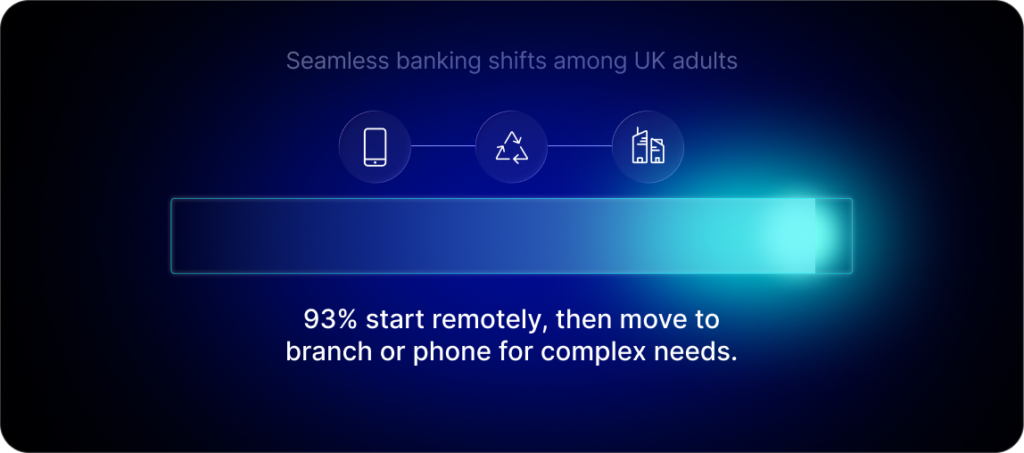
- 93% of UK adults now engage via remote/digital banking, often starting online and ending with branch or phone interactions.
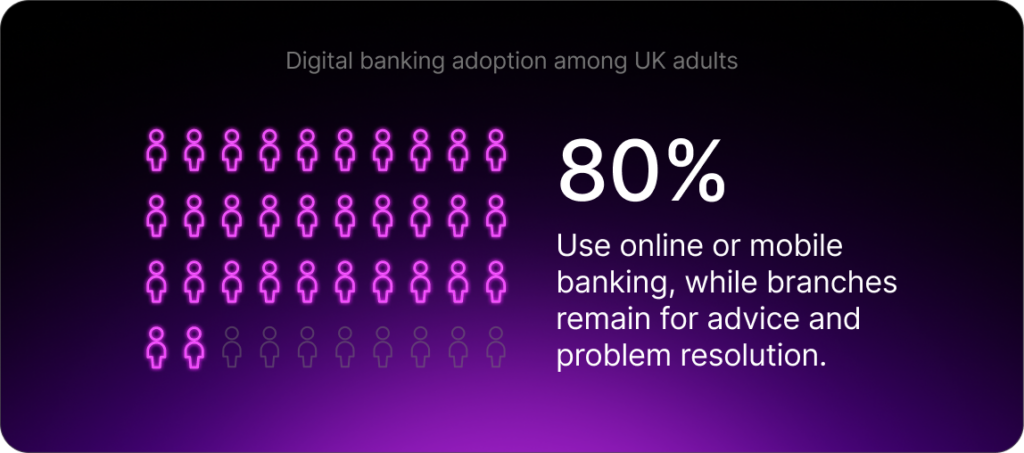
- Over 80% of UK adults using online or mobile banking in 2023, yet visits for advice remain resilient.
Branches are shifting from transaction counters to spaces where members seek reassurance, explanation and advice on complex financial decisions. For building societies, this creates an opportunity to treat the branch not only as a physical location but as part of a broader advice-led network spanning branches, mobile advisers, contact centres and digital channels. The question is less about “how many branches” and more about “how easily can a member reach the right person, in the right context, with the full picture of their relationship?”
Quick primer: Redefining the building society branch network
Industry data shows that while routine transactions continue to move online and to mobile, with over 80% of UK adults using online or mobile banking in 2023, visits for advice and problem resolution remain resilient. Members expect to start a journey on their mobile device and pick it up in a branch or via video, without having to repeat their story or rekey information. For building societies, this means rethinking branches as nodes in an integrated network, where advisers can move between in-branch, community settings and remote conversations with access to the same tools and member information.
In practice, this requires simplifying the underlying technology stack. Many institutions still rely on separate systems for teller activity, onboarding, CRM and servicing, which increases error rates and leads to duplicated questions for the member. As more journeys start digitally, these gaps become more visible and frustrating, especially in complex products like mortgages or savings with specific conditions.
Why this shift matters for building society branch networks?
Three trends are converging for building societies:
- Members increasingly expect seamless movement between self-service and assisted channels as 93% of UK adults now engage via remote/digital banking, often starting online and ending with branch or phone interactions for complex needs.
- Trust and human interaction remain core differentiators versus digitally native competitors, particularly in communities where there is a greater need to support older or more vulnerable members.
- Regulatory expectations around suitability, KYC and record-keeping are rising, making inconsistent tooling and fragmented data harder to defend.
The emerging operating model is an “everywhere network” where physical branches, shared community spaces, mobile advisers and digital channels work together. Members can start on a website, continue in a pop-up or branch, and finish via video or call back, with information flowing through the journey. Cloud-based tools, shared data models and open integration frameworks are enabling this kind of configuration. This allows smaller institutions to experiment with pop-ups, shared locations and hybrid models without committing to traditional long-term branch leases.
What’s happening on the ground?
Many mutuals and regional institutions are already piloting pop-up concepts: smaller format branches, shared spaces and advisers equipped with tablets at events or partner locations.
Early evidence from these pilots indicates:
- Higher satisfaction scores where members can choose how they engage and avoid repeating information.
- Increased conversion and cross-sell in advice-led interactions compared to purely transactional visits.
- Better data on network performance, including identification of “hot” and “cold” areas for face-to-face presence.
The branch, in this sense, becomes a relationship network, not a single building.
How SBS Digital Branch fits in
SBS Digital Branch connects directly to a banking core system as a SaaS platform, addressing immediate pain points while scaling for future networks and engagement models. It combines account management, smoother and smarter onboarding, teller operations and full passbook support, so any user can provide a compliant and personalised service anywhere and with a complete view of the members.
Digital Branch unifies customer journeys with reusable flows across every channel, eliminating fragmentation. It centrally manages updates and integrations, empowering advisers to deliver shared, intuitive experiences that adapt to customer expectations and enhance engagement.
The result: lower fixed costs, protected and growing advisory revenue, time-to-value in months, not years, and a modern, agile platform ready for the future of assisted banking.
It’s not about being “tied to the legacy of branches” or going “all digital”. SBS Digital Branch is an alternative option that combines the benefits of both: a modern SaaS platform for engaging your customers directly that keeps the human connection alive, extends your reach far beyond buildings, and makes changes faster and safer than current legacy systems. It’s how you retain a world driven by relationships, not just locations.
Questions and Answers
Despite more than 80% of adults in the UK accessing online or mobile banking, some are still very reliant on visiting physical branches and many prefer to have a conversation face-to-face for advice about big life events or to resolve problems. However, they expect seamless journeys in which they don’t have to repeat key information. This means that advisers can move between in-branch, community settings and remote conversations with access to the same tools and member information.