
- Banks aggressively adopting cloud and AI have reduced their cost-to-income ratios by 452 basis points compared with peers.
- Generative AI could drive revenue increases of up to 4.9% and improve pre-tax profit growth by as much as 29%.
- Only 4% of banks are currently ready to scale generative-AI-driven transformation across the enterprise.
Core banking has long been the operational backbone of banks, but it has also become one of their most significant structural constraints. Originally designed to support core banking activities such as managing accounts, processing payments and issuing loans, many systems have evolved over time into highly complex, fragmented environments shaped by decades of technological limitations, regulatory change and shifting strategic priorities. As a result, many legacy cores now struggle to support the realities of modern banking, from rising regulatory complexity and persistent cost pressure to customer expectations for real-time, highly personalized services.
For more than 20 years, banks have poured investment into digital transformation to modernize access, automate processes and improve customer experience. While these efforts have delivered important gains in efficiency and usability, execution has often been uneven, leaving many institutions with increased complexity rather than truly modern cores. At the heart of this challenge lies data. Banks remain rich in data, but much of it is fragmented, inconsistently governed and difficult to activate across core systems, limiting its ability to drive timely, actionable insight.
The next phase of core banking evolution will therefore be shaped not by digitization alone, but by the systematic embedding of artificial intelligence across core operations, turning the digital core into an intelligent one.
What does AI in core banking really mean?
There’s no doubt that AI has become one of the most talked-about technologies across many industries, and banking is no exception. Chatbots, workforce reduction and fears of opaque, black-box decision making tend to dominate the conversation. Yet these use cases only scratch the surface of the impact that AI could have on the banking sector. The most transformative impact of AI will not be found at the edges of the organization, but at its core.
In practice, AI in core banking means embedding intelligence directly into the systems that govern products, pricing, servicing, risk and day-to-day operations. Rather than operating as isolated tools, AI capabilities become woven into core processes, enabling banks to analyze data in real time, surface insights through natural-language interfaces, and support faster, better-informed decisions across the organization.
The business impact of AI-enabled core banking
AI in core banking is no longer theoretical. Leading banks are already deploying real-world use cases that demonstrate its ability to transform operational efficiency, accelerate product innovation, strengthen compliance, and improve revenue performance. And this is just the beginning.
Operational efficiency and cost reduction
By embedding intelligence directly into workflows, banks can provide faster access to information, reduce manual investigations, and minimize repetitive explanations and reconciliations across teams. AI-driven automation of documentation, testing, monitoring and vulnerability detection is already delivering measurable gains. In one modernization program conducted by Bancolombia in 2025, AI allowed for an increase in test script creation speed of 400%, while also delivering 30% of new features without adding technical debt. These improvements reduce rework, accelerate cycles and lower long-term maintenance costs.
The broader financial impact is significant. Research conducted by Accenture shows that banks that aggressively adopt cloud and AI have reduced their cost-to-income ratios by 452 basis points compared with peers.
Faster time-to-market
Embedded intelligence supports AI-assisted product discovery and design, enabling teams to move from concept to launch with far greater speed and flexibility, while reducing dependency on already stretched IT functions.
Rather than months of manual configuration and validation, banks can simulate scenarios before launch, test at scale and refine features continuously. The result is shorter development cycles and more agile responses to regulatory and market change.
Improved governance and compliance
When embedded directly within core banking systems, AI enables continuous regulatory awareness, explainable decision-making and fully traceable audit trails. This allows banks to move beyond periodic reviews and static controls, shifting toward real-time, intelligence-driven risk and compliance management.
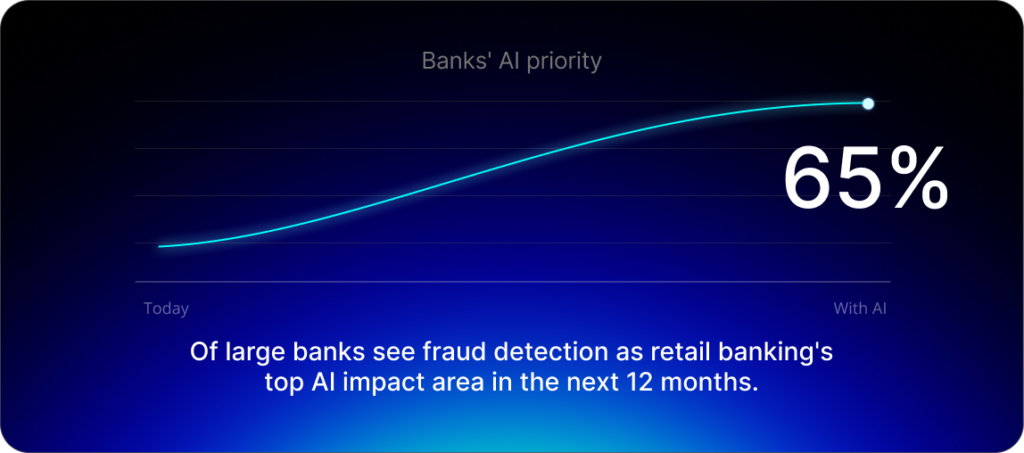
Fraud detection is one of the most immediate applications of this model. It is now a top AI priority for many institutions, with 65% of large banks and 77% of credit unions identifying it as the retail banking area most likely to be impacted by AI in the next 12 months.
Better revenue performance
AI in core banking also enhances top-line performance. By centralizing product, pricing and billing intelligence, banks can make smarter product decisions while continuously monitoring adoption and performance in real time. This allows for dynamic adjustments rather than post-mortem corrections.
Industry projections suggest that generative AI could drive revenue increases of up to 4.9% and improve pre-tax profit growth by as much as 29%. In markets where differentiation is increasingly difficult, competing on intelligence rather than scale becomes a tangible advantage.
| Area | Metric | Business impact |
| Revenue performance | Revenue uplift | Up to +4.9% |
| Cost efficiency | Reduction in operating expenses | Up to −7.7% |
| Profitability | Pre-tax profit improvement | Up to +29% |
Why architecture matters: AI needs a modern core
Clearly, AI is already playing an important role in banking. Before long, the technology will be an indispensable part of a modern bank’s technology architecture. However, AI does not operate in isolation. It requires real-time data flows, centralized logic and clean, governed information to function effectively at scale.
Legacy core systems, built for batch processing and fragmented product structures, were never designed to support continuous intelligence. In many institutions, product, pricing and billing logic remain dispersed across multiple platforms, limiting visibility and preventing AI from generating consistent, enterprise-wide insights. At the same time, poor data quality and siloed ownership continue to constrain automation, explainability and regulatory confidence.
A modern, AI-ready core must therefore be real-time and API-first, centralizing critical business logic while exposing high-quality, well-governed data across the organization. Just as importantly, it must enable business users to design, test and adapt products and processes without constant IT intervention, allowing intelligence to be operationalized rather than trapped in technical layers. The scale of the challenge is significant. Despite growing investment in AI, only 4% of banks are currently ready to scale generative-AI-driven transformation across the enterprise. For most institutions, the barrier is not ambition or use-case availability, but structural readiness.

Implementing AI in core banking: from vision to execution
Future-ready core banking systems must support explainable AI, ensuring transparency and regulatory confidence across automated decisions. They must provide business-ready assistants that translate complex data into actionable insights for operations and product teams. And they must deliver secure, compliant intelligence that integrates seamlessly across the digital core.
At SBS, these principles are already being put into practice. Through our AI-native SBS Digital Core, we are embedding intelligent capabilities directly into core banking processes, enabling banks to move beyond digital execution toward continuous, data-driven decision-making. By combining modern, real-time architecture with embedded AI across products, pricing, servicing and governance, SBS helps banks transform their core from a system of record into a true engine of intelligence.
Contact a member of our team today, and find out how we can help your organization to go from digital core to intelligent core.
Question and Answer: AI in core banking
An intelligent core refers to a modern core banking architecture where AI is embedded directly into core processes such as product management, pricing, servicing, risk and compliance, enabling real-time, data-driven decision-making across the bank.