

#Asset Finance
- Dealers hide units, sell financed inventory for cash without paying off their line, and submit fake documents.
- Digital audits can be completed as frequently as once a week in very high-risk situations.
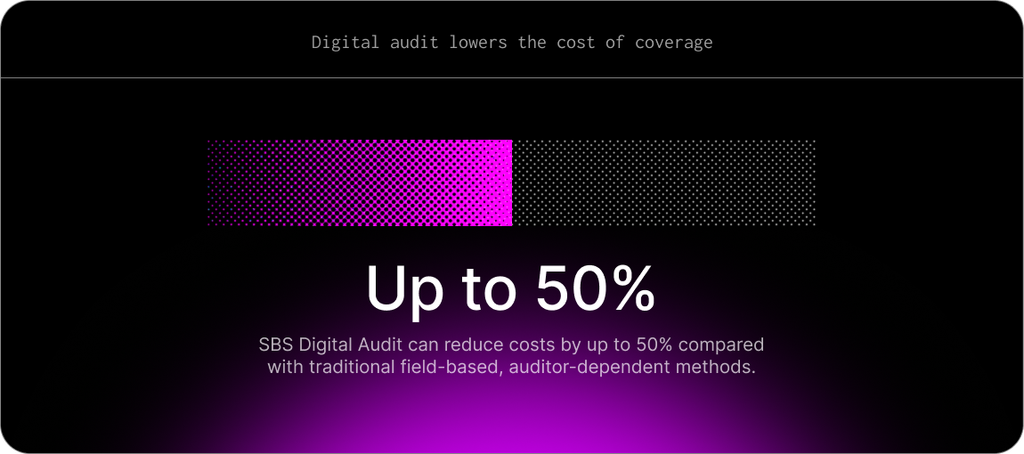
- SBS Digital Audit can reduce costs by up to 50% and save over 40% of time.
Ask a floorplan lender how confident they are in their risk exposure across their funded asset portfolio, and most will point to their audit program. Ask when the last physical audit happened at a given location, and that confidence tends to soften. An inventory audit conducted by a physical auditor, however well it’s executed, is a snapshot of a single point in time with significant intervals between audits. Between scheduled visits, months can pass without anyone confirming that a piece of collateral is still under control of the relevant dealer and located where it’s supposed to be. At the same time, we are seeing an increase in the types of fraud that exploit this gap, including dealers hiding units, selling financed inventory for cash without paying off their line, and submitting fake documents to get past an audit. Increasing physical audit frequency becomes an incremental high-cost expense competing against a better risk visibility across a funded portfolio. This is a dilemma where, in most cases, lenders cannot obtain additional incremental budget to support increased audit frequencies; while additional bandwidth and audit resource limitations within physical audit services also removes the option for all but, high-risk situations. That’s where digital self-audit comes in. For many floorplan lenders, it’s now taking a minor or majority proportion of their existing audit schedule, reducing program costs and adding incremental audits when increased scheduled dealer audits or a specific risk event calls for a closer look.
What a physical audit cadence misses
Most floorplan lenders conduct inventory audits based on a budget or auditor availability impacting the number of audits required annually to keep their risk in check. Acceptable loss percentages are a key consideration in what the audit frequency model looks like for each lender. Then, during the year, a physical check by an auditor documents what inventory looked like when someone walked on the lot. Problems like missing inventory, curtailment fraud, where a dealer avoids paying down a unit that should have been settled, and title control failures are all built to exploit the time between one visit and the next.
Floorplan fraud can take many forms, curtailments, sold out trust assets, missing units, miss declared demonstrators and a host of other reasons. It takes someone actually checking that specific unit, an auditor confirming it in person, or a digital self-audit comparing submitted evidence against the record to catch the gap between what’s reported and what’s true.
How hybrid audit coverage works
A hybrid audit program pairs a physical audit cadence with a digital self-audit capability that lenders can deploy far more frequently, in both normal operational and high-risk situations, than a traditional physical audit based scheduled lot visit allows.
A self-service audit enables dealers and borrowers to complete guided audits on a mobile device; capturing images and any additional evidence required by the lender for each asset to prove control, condition and location. Based on a lender’s business model and processes, automated controls then validate the evidence against prior audit history in combination with portfolio data and business rules, flagging anything that doesn’t line up.
For lenders, digital audits can be completed at regular intervals, and as frequently as their risk dictates, such as once a week or even daily in very high-risk situations. The cost of sending physical auditors to each site once a week would exceed the potential upside of realizing risk early, so this is a way to increase the frequency without the significant additional overhead of physical auditors.
Beyond increased audit frequency, the simple download of an App means that digital self-audits can be deployed immediately and at scale wherever risk arises. That means a lender can trigger an additional look when a specific risk event calls for it, allowing them to stay on top of risk.
NextGear Capital, one of the largest floorplan lenders in the U.S., has built exactly this kind of self-audit capability into its dealer mobile app.
“Working alongside SBS, we’ve provided a self-audit solution that clients can access right inside our mobile app, which is a key step in our audit transformation journey,”
said Nicole Graham-Ponce, VP of Portfolio Management at NextGear Capital.
The benefit of the digital audit is that, when the physical audit happens, it confirms what was already suspected rather than checking risk for the first time.
Where SBS fits in
SBS Digital Audit is floorplan audit software built to serve as the digital component of a hybrid audit model, giving lenders a risk monitoring platform they can use alongside their existing physical program. Digital self-audit capability gives lenders a fast, flexible way to augment their audit schedules or respond to a specific risk signal, backed by automated verification that flags issues such as offsite units or fraud attempts as they’re identified. This enables lenders to have visibility in the interim so they can mitigate risky situations earlier. A key part of that flexibility is that SBS doesn’t work with a single audit provider. The platform is compatible with any physical audit vendor, can be used by internal teams, and every one of those workflows runs through the same system.
Explore SBS Digital Audit to see how pairing physical audits with frequent digital self-audits fits into your floorplan finance portfolio.
Q&A: Questions on digital self-audits and continuous monitoring
Missing inventory, curtailment fraud, and collateral audit exceptions are among the most common issues a hybrid program is built to catch. These can typically surface in the gap between physical audits, when a unit has been sold, moved, or altered without the lender’s knowledge.
A physical auditor inventory check captures what’s true at a single point in time, and a monthly, quarterly, biannual or annual cadence means weeks or months can pass between one visit and the next at any given location. Problems like missing inventory or a dealer avoiding curtailment payments are built to surface and resolve inside that window, often before the next scheduled audit catches them.
Digital dealer self-audits are self-service; with borrowers, internal audit teams, or third-party auditors also able to use the solution to complete guided audits from a mobile device or portal, submitting photos and other evidence for each asset. Automated controls validate evidence against expected values and audit history, flagging anything that doesn’t match, so lenders can run digital checks more frequently and direct physical audits to the assets and locations that need them most.
Beyond, the financial, augments risk control and internal resource efficiencies that benefit the lender; a dealer’s self-service audit generally is quicker to complete rather than being bound to assisting a physical auditor working their schedule. It also gives dealers and borrowers a clear, low-friction way to stay in good standing. For lenders, that willingness to participate makes frequent digital checks practical rather than periodic disruption.
Digital self-audits are well-suited to frequent risk checks across the portfolio and can be deployed quickly wherever a risk signal calls for a closer look. Depending on the deployment model, SBS Digital Audit can reduce costs by up to 50% and save over 40% of time compared to traditional field-based, auditor-dependent methodologies.
No. A hybrid model can support multiple audit completion sources at once, including self-audit, a lender’s internal audit team, an existing third-party auditor, or a new provider the lender selects, as well as dedicated audit partners. Additionally dynamic controls can automatically adapt to dictate who should perform an audit based internal lender business rules or changes in the market. The goal is for every workflow to run on a single platform, regardless of which provider performs the physical work.