- The aim of the new EBA framework is to simplify the reporting process, reduce the burden on banks, and strengthen Europe’s banking sector.
- The revised reporting measures are expected to take effect from September 30, 2027.
- New requirements under IFRS 18, ESG, and the Fundamental Review of the Trading Book (FRTB) will be integrated into the framework.
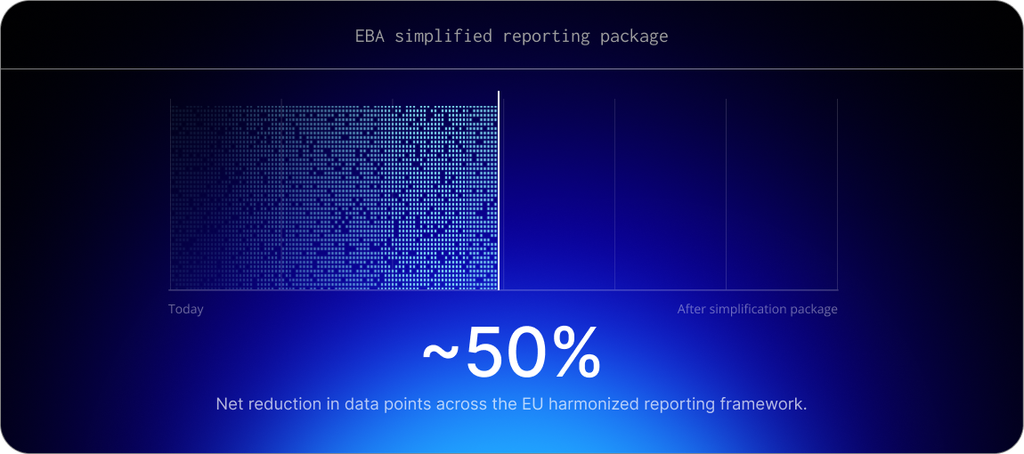
The European Banking Authority (EBA) is planning to introduce new regulatory reporting measures aimed at simplifying the process, reducing the burden on banks and strengthening Europe’s banking sector by making it more competitive. According to the EBA, the simplification package will result in an overall net reduction of about 50% in the data points of the EU harmonized reporting framework that covers regular reporting, QIS, and EU-wide stress test data collections.
In its most extensive review of the framework in more than a decade, the EBA said the centrepiece of its revision is the ITS on supervisory reporting, which rebalances the framework toward “need-to-have” information. It added that this will deliver a 16% reduction in data points in the harmonized reporting framework and will be complemented by lower frequencies, increased proportionality, and the integration of ad hoc data collections.
“The European Banking Authority is advancing a comprehensive set of simplification and efficiency measures to ensure that supervisory reporting across the EU becomes simpler, smarter and more proportionate,” the EBA notes in a recent report.
“This initiative takes a holistic approach: it addresses both the stock and the flow of EU-level reporting requirements; it strengthens coordination of European and national reporting; and it lays the foundations for integrated reporting and enhanced data sharing,” it adds.
The consultation stage of the initiative has ended and the EBA expects the final text to be ready by the end of the year. The new framework is slated to take effect from September 30, 2027, giving banks less than a year to prepare for significant operational changes.
What measures are in the EBA’s simplification package?
The EBA has emphasized that the package aims to reduce the reporting burden for EU banks while ensuring that supervisory authorities continue to receive the information they need to fulfill their supervisory responsibilities.
“The new approach would reduce unnecessary burden while preserving the quality and relevance of the information supervisors need. It should also support easier data sharing and more integrated reporting across Europe,” EBA chair François-Louis Michaud said in April.
The changes will affect all areas of the framework beyond the headline data point reduction, including:
- A net reduction of about 50% in the QIS and stress test data points, despite including new requirements under IFRS 18, ESG, and the Fundamental Review of the Trading Book (FRTB). It will also be applied to the supervisory benchmarking (SBP) collections, which do not necessarily concern every institution in the market.
- Integration of the previously separate EU-wide stress test and SBP collections into regular reporting, reducing these data points by about 55% and up to 65%, respectively. This does not mean they are being discontinued. Only part of the data will be integrated into the COREP, FINREP, and ESG collections, while some data, particularly projections, will still have to be produced directly in the QIS and stress test collections.
- Additionally, the reduction in data points for the QIS and stress-test collections will not take effect until 2029. However, from 2027, institutions should work on aligning the duplicated requirements between the QIS and stress test collections and regulatory reporting as the data can be reused.
- Reduced reporting frequencies and a narrower scope for a range of templates.
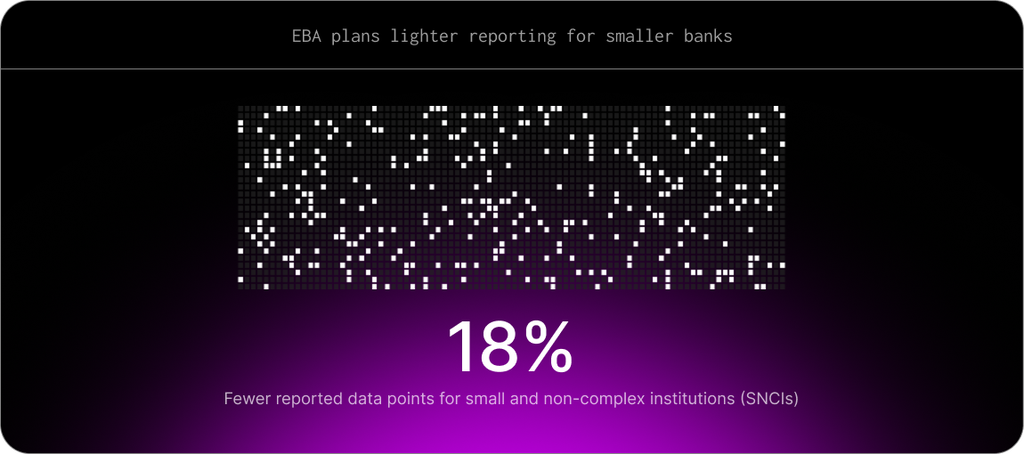
- Greater proportionality for small and non-complex institutions (SNCIs) through a “core plus supplement” approach, limiting them to a core template set and providing an 18% reduction in reported data points.
- Aligned definitions across reporting frameworks to avoid overlap and duplication.
- A public EU-wide repository of supervisory data requests, backed by guidelines to coordinate how European and national authorities design and record requests.
- A more stable change cycle with reporting updates limited to one or two releases a year.
What does the new EBA reporting framework mean for banks?
The EBA’s revised reporting package is not simply about reducing reporting obligations, it reflects a shift toward integrated, data-driven regulatory reporting.
Although the number of templates and data points will decrease, banks will need to modernize their data governance and reporting architecture to meet regulatory requirements under the new framework. They will also have to revise mappings, data dictionaries, validation controls and production processes and then test the results.
In my view, it is unlikely that the Data Point Model (DPM) 4.4 changes will require this overhaul of data governance and architecture. However, as the EBA is clearly moving toward increasingly granular and integrated reporting, now is the right time to start that work.
Meanwhile, the EBA’s longer-term aim, developed in conjunction with the Joint Bank Reporting Committee, is focused on trusted sources of data that extend across prudential, resolution, and statistical reporting through a common data dictionary.
This means that banks will have to move away from filling out templates and shift their focus to data governance, such as definitions, traceability and consistency in FINREP, COREP, ESG, stress tests, and benchmarking.
How can banks prepare for the changes?
Banks are under pressure to begin assessing the operational impact as soon as possible, allowing them to prepare their reporting architecture well ahead of the September 2027 deadline.
Preparation is key, as the simplification of EBA reporting should not be mistaken for deregulation. While the EBA is seeking to make the framework more readable, coordinated, and efficient, the changes mark a shift away from reporting based on accumulation to reporting based on optimization.
SBS Regulatory Reporting supports banks and financial institutions in anticipating and automating their regulatory obligations, including impact analysis, native implementation of controls, data traceability, coverage of European and local requirements, and adaptation to changes in the data point model.
Faced with a more integrated framework, the ability to produce reliable, controlled, and scalable reporting will become a key operational advantage for banks as they adapt to the EBA’s simplification package in the coming months.
Want to know more about regulatory simplification, automation and new reporting obligations? Contact our SBS Regulatory Reporting experts and turn compliance into a competitive advantage.
Q&A: Key questions on the EBA reporting framework
The final text for the revised framework is expected to be ready by the end of 2026, following a public consultation period that ended in July. The new reporting measures are slated to take effect from September 30, 2027.