
#Core Banking
- Nearly 90% of organizations cite data quality among their top concerns during ISO 20022 transition.
- Compliance can no longer operate as a separate layer applied after processing.
- Modernization is no longer optional, but the way it is executed will determine who retains relevance, resilience and operating leverage.
Payments transformation in French-speaking Africa has moved beyond growth: it is now a strategic control issue for banks. As digital financial services scale rapidly and regulators accelerate interoperability, instant payments and reporting reform, banks must modernize the payments stack without losing control of customer relationships, compliance execution or economics. The challenge is not momentum but fragmentation. Across UEMOA and CEMAC, payment infrastructures remain split between interbank rails and mobile money ecosystems, while banks, fintechs and telecom operators still operate with limited standardization and interoperability.
Regulators are now forcing convergence through instant payment infrastructure, interoperability frameworks, stronger supervisory reporting and shared standards. The implication for bank leaders is clear: modernization is no longer optional, but the way it is executed will determine who retains relevance, resilience and operating leverage in the next payments model.
The question for payments transformation in French-speaking Africa is no longer whether to modernize, but where to move first and how to do so without compromising customer experience, compliance or strategic control of the value chain.
Three pillars restructuring the payments ecosystem
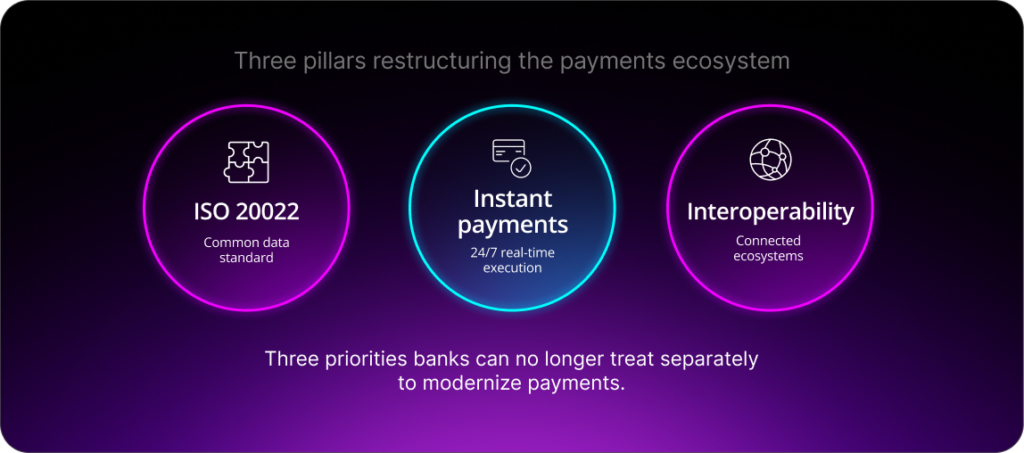
This new model rests on three priorities that banks can no longer treat separately: common data standards, real-time execution and ecosystem interoperability.
ISO 20022
ISO 20022 is becoming the foundation of payments modernization because it gives banks, fintechs, clearing systems and regulators a common, structured data language.
For banks, the value is practical: less friction between systems, better data consistency, easier reconciliation and a stronger base for reporting, compliance and future AI-enabled use cases.
As reporting obligations intensify under Basel-aligned frameworks, institutions that cannot produce granular, reliable and structured data at scale will face growing operational and regulatory pressure.
Instant payments
Instant payments are becoming a baseline expectation, not a premium feature, and they matter especially in markets where mobile money is already central to daily transactions.
For banks, this is both an inclusion opportunity and an execution challenge: they must deliver 24/7 availability, speed and reliability in environments where customers increasingly expect digital transactions to work instantly and seamlessly.
Done well, instant payments can reduce reliance on cash, improve user experience and increase the circulation of digital value across the economy.
Interoperability
Interoperability is the third priority because growth has happened in silos. Banks, fintechs and mobile network operators have expanded rapidly, but too often on separate rails that limit seamless interaction.
For regulators, interoperability is the route to a more unified ecosystem; for banks, it is the condition for remaining relevant in a market where customers increasingly expect payments to move across networks without friction.
This shift is already visible in regional initiatives such as GIMAC Pay, which signal the direction of travel: shared standards, common infrastructures and greater cross-ecosystem connectivity.
| CEMAC | UEMOA | |
| Supervisory infrastructure | Spectra II platform, developed by COBAC, centralizing supervision of banks, payment institutions and microfinance institutions | FODEP framework supporting transmission of prudential data |
| International regulatory framework | Convergence toward Basel III (R-2025/02) | Basel II/III framework deployed since 2018 |
| Reporting scope | Financial position, prudential ratios, risk exposure and AML/CFT framework (via eCERBER) | 39 regulatory reports covering capital, risk-weighted assets and liquidity ratios |
| Reporting frequency | Quarterly reporting on portfolio quality | Regular reporting obligations across prudential, AML/CFT and FX operations |
| AML/CFT requirements | Included within supervisory reporting framework | Structured AML/CFT framework with regular reporting on customer knowledge and suspicious transactions |
| Scope of institutions | Applies to banks, payment institutions and microfinance institutions (EMF), with aligned requirements | Applies to banking institutions under regulatory framework |
| Additional requirements | Minimum capital raised to 25 billion FCFA | Foreign exchange regulation (R06/2024) extending reporting on cross-border operations |
| Enforcement | Penalties for delay or non-compliance | Penalties for delay or non-compliance |
Embedding compliance into payment flows
Alongside infrastructure modernization, regulatory compliance is becoming a defining dimension of payments transformation. As transaction volumes increase and systems become more interconnected, banks face growing pressure to strengthen controls across onboarding, transaction monitoring and reporting.
This includes aligning with international frameworks such as anti-money laundering (AML) and counter-terrorist financing (CFT) standards, as well as strengthening know-your-customer (KYC) processes. In practice, this requires more robust customer identification, Politically exposed persons (PEP) screening mechanisms and greater consistency in how data is captured and validated across systems.
The shift toward ISO 20022 plays a critical role in this context. Richer, structured data improves the quality of information available for compliance checks, enabling more effective monitoring and reducing the risk of errors or omissions.
However, this also raises the bar for banks. Compliance can no longer operate as a separate layer applied after processing. It must be embedded directly into payment flows, ensuring that transactions can be validated, screened and executed in real time without introducing friction.
What makes implementation complex for banks?
While the path ahead for this transformation journey is increasingly clear, delivering on these priorities is complex. Each introduces a distinct set of challenges, and taken together, they require banks to rethink how systems, data and ecosystem relationships are structured.
Moving to a common data standard (ISO 20022)
Transitioning to ISO 20022 is not simply a matter of adopting a new format. Most banks operate with heterogeneous data models, legacy systems and institution-specific interpretations of payment information. Moving to a shared standard requires aligning how data is structured, defined and used across the organization, ensuring that it remains consistent when exchanged with external actors.
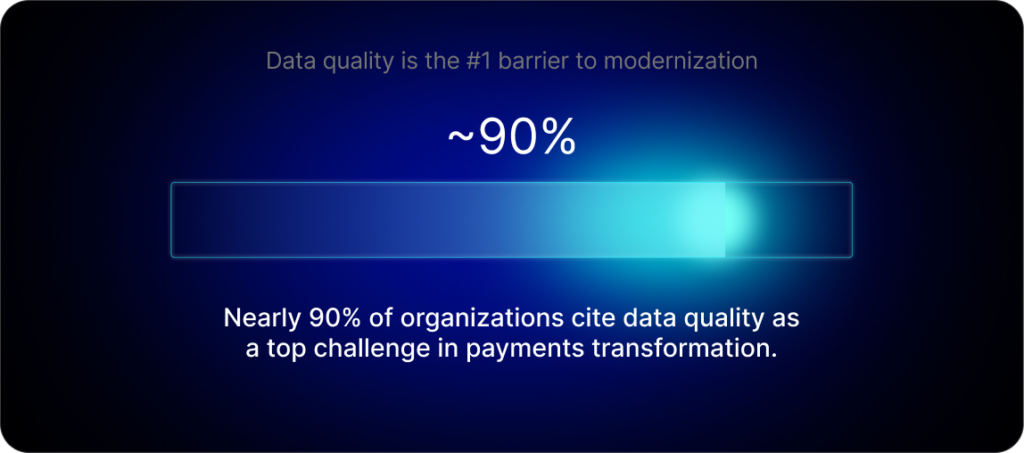
This shift often exposes underlying data quality issues and inconsistencies. Industry evidence shows that data quality is a leading challenge for organizations, with nearly 90% citing it among their top concerns.
Supporting real-time execution (instant payments)
Enabling instant payments requires a fundamental change in how payment systems operate. Many existing infrastructures were designed for batch processing, with sequential workflows and defined processing windows. Real-time execution demands continuous availability, faster processing speeds and greater operational resilience.
It also increases the importance of accuracy, control and audit trails. Transactions must be validated and processed immediately, leaving little room for manual intervention or post-processing adjustments.
Breaking down ecosystem silos (interoperability)
Achieving interoperability is not only a technical challenge. Banks, fintechs and telecom operators have evolved independently, with different systems, standards and operating models. Connecting these actors requires alignment across interfaces, data exchange protocols and governance frameworks.
In addition, interoperability often depends on shared infrastructures with multiple participants. This introduces coordination challenges, as progress is no longer determined by a single institution, but by the collective readiness of the ecosystem.
How can banks overcome the challenges of payments transformation in French-speaking Africa?
Banks will overcome these challenges only if they approach modernization as an integrated transformation of data, compliance, processing and ecosystem connectivity rather than as a series of isolated upgrades.
SBS Core Amplitude is designed to help banks execute that shift by improving data reliability, embedding regulatory reporting into core processes and supporting the operating requirements of real-time, interoperable payment environments.
Built for the regulatory realities of CEMAC, UEMOA and similar markets, it enables banks to adapt to local obligations while maintaining a consistent, scalable and integrated approach to payments data and compliance.
The result is a stronger payments operating model: less fragmentation, better control, faster compliance execution and a more resilient foundation for instant payments and interoperability at scale.
Three takeaways for bank leaders
First, payments modernization is now a strategic priority because control, compliance and customer experience are converging in the same operating model. Second, success will depend on sequencing the right moves across data, real-time execution and interoperability rather than tackling each topic in isolation. Third, banks that build this foundation early will be better positioned to meet regulatory demands, capture digital transaction growth and defend relevance in a more connected ecosystem.
Contact a member of our team today to find out more.
Q&A: Payments Transformation in Africa
Growth in digital financial services and mobile money is accelerating transaction volumes, while regulators are pushing for more unified, interoperable and standardized payment systems.
ISO 20022 enables richer, structured data exchange, reducing friction between systems and supporting both interoperability and more effective compliance and reporting.
Banks must modernize legacy systems, ensure real-time processing, improve data quality and align with increasingly complex regulatory and reporting requirements.
Regulators are expanding reporting obligations and strengthening supervisory frameworks, while also driving the development of interoperable payment platforms and promoting instant payments as a lever for financial inclusion (for example, BCEAO with PI-SPI, and BEAC with GIMAC Pay and the upcoming PS-IIPS).