
- Fraud operations are increasingly designed for higher success rates, higher financial impact and greater resistance to traditional controls.
- Deepfake fraud attempts nearly doubled in the UK to 94% in 2025, second only to France at 96%.
- Synthetic identity is expected to be the fastest-growing AI fraud threat over the next 12 months.
Earlier this year, in one of the clearest signs of agentic AI fraud reaching the public, Banca d’Italia issued a warning to the public about fake images, videos and articles circulating online that unlawfully used the name and image of the central bank’s governor, Fabio Panetta. “These materials portray him – in a completely fabricated manner – as taking part in well-known television programs or other media contexts, sometimes in association with the promotion of investment platforms. Such content is also created using an artificial intelligence technique, known as deepfake,” the central bank said in a statement in February.
Italy’s example reflects just how quickly generative AI has evolved into agentic AI, with central banks worldwide increasingly warning consumers of a surge in deepfake financial scams that impersonate bank officials, well-known company CEOs or celebrities.
In the past, there were red flags that gave fraud away – clumsy grammar, poor spelling and robotic-sounding voices – but these have been engineered out by agentic AI. According to a 2025 study by Feedzai, 92% of financial institutions say fraudsters use generative AI, but 44% have seen an increase in agentic AI deepfakes in scams. Agentic AI has not invented new crimes; instead, it has stripped out the red flags and errors of old. When SBS examined digital banking fraud in 2024, the shift was already underway. Two years on, the fakes have become more sophisticated and cheaper to manufacture at scale.
Here, we look at the AI trends driving financial scams in 2026.
Trend 1: AI deepfakes against bank customers and staff
Visual deep fakes now reach across both ends of a bank: the customer impersonated and the staff member misled. According to a 2024 study by Regula, 23% of financial firms reported losing more than US$1 million to AI-generated fraud.
A report by Sumsub, which studied more than 4 million fraud attempts in 2025, found that AI is reshaping identity crime as “attackers move from volume to precision”.
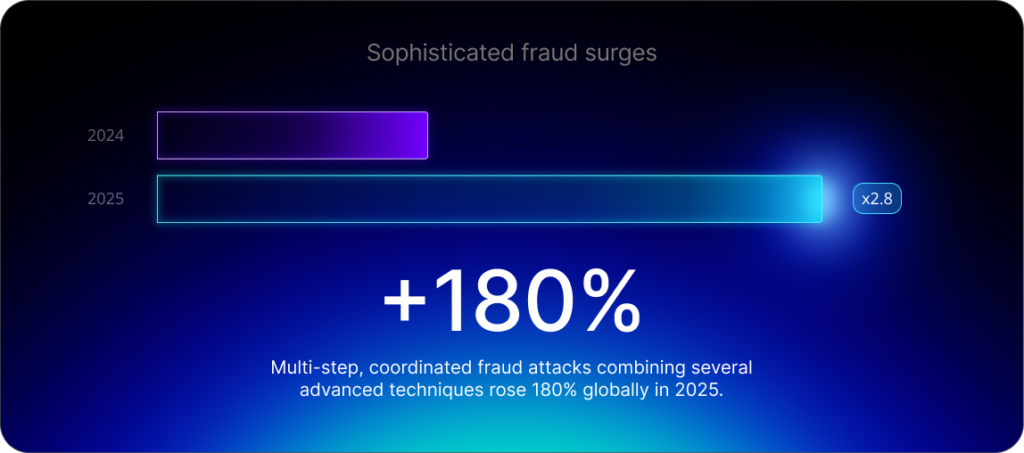
“The study finds that sophisticated fraud – multi-step, coordinated attacks that combine several advanced techniques within a single verification attempt – has risen 180% globally in 2025,” Sumsub says in the report.
“This is the sophistication shift: fraud operations are increasingly designed for higher success rates, higher financial impact and greater resistance to traditional controls, meaning that fraudsters now need far fewer attempts to carry out a successful attack,” it adds.
This coordination of many techniques into a single attack is the hallmark of agentic AI fraud. The Sumsub study also found that that 72% of EU countries expect more sophisticated attacks using AI, particularly involving deepfakes and AI-generated identity documents. Deepfake fraud attempts nearly doubled in the UK to 94% in 2025, second only to France (96%), followed by Spain (84%) and Germany (53%).
Meanwhile, one-in-five fraudulent verification attempts in Europe in 2025 involved an edited or forged ID document, while 87% of Europeans don’t know or understand what money muling is, making them more vulnerable to scams designed to transfer illegally obtained funds, Sumsub says. In the UK, investment scam losses reached £97.7 million in the first half of 2025, up 55% year over year and accounting for 35% of all authorized push payment losses, according to a report by UK Finance, which says that the rise in deepfake videos has enhanced the credible risks of fraudulent investment schemes.
Trend 2: Synthetic identity at bank onboarding
According to a 2026 report by BNY, a synthetic identity can be assembled (not stolen) where an identity is cobbled together from real, lifted and invented details, then used to open accounts.
Real personal data, such as an ID number, can be used with a fabricated address and name to create a fake person, while generative AI can create valid-looking documents, including passports and driver’s licenses, BNY adds. It is a growing threat, with 61% of fraud/risk executives at financial institutions saying synthetic identity will be the fastest-growing fraud threat over the next 12 months, BNY notes in the report.
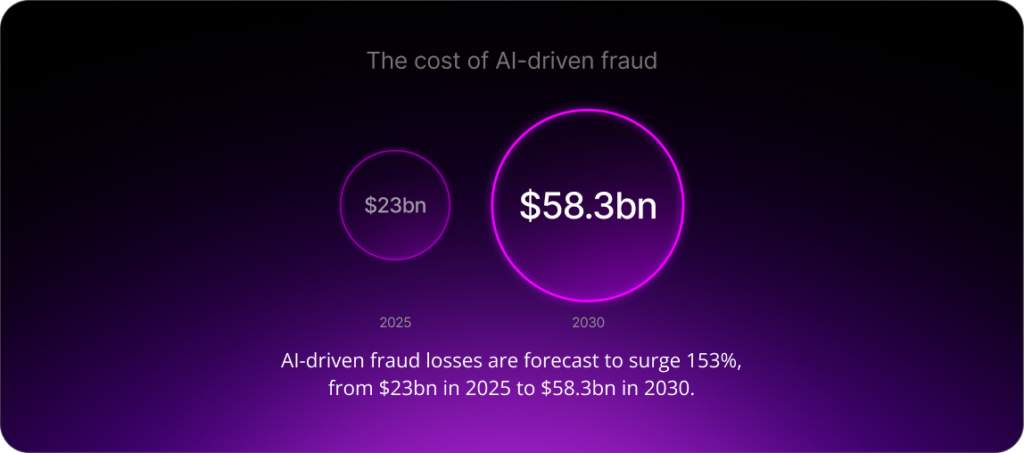
Meanwhile, Juniper Research has forecast a 153% surge in AI-driven fraud, from $23 billion in 2025 to $58.3 billion in 2030, driven primarily by techniques such as synthetic identity fraud.
Trend 3: The EBA’s agentic AI warning and fake identity surge
In July 2025, the European Banking Authority (EBA) issued an opinion on money laundering (ML) and terrorist financing (TF), warning that criminals use agentic AI to automate schemes, conceal fund sources and make high-risk transactions harder to detect.
“The expansion of cybercrime and fraud, driven by technological sophistication, continues to outpace the sector’s defensive capabilities,” the EBA said. “Financial institutions face challenges in detecting sophisticated AI-driven attacks that are increasing in both volume and velocity.”
The EBA added that these types of threats require advanced technologies and specialized expertise. It also highlighted the need for responsible AI deployment, supported by robust governance, staff training and real-time monitoring capabilities. Meanwhile, the Sumsub report found that tools such as ChatGPT and Gemini now account for 2% of falsified documents processed globally and is anticipated to drive double-digit growth for this type of fraud in 2026.
“Automation will make cross-channel manipulation and orchestration more accessible,” Sumsub warns. “In turn, we will see synthetic identities and fraud-as-a-service toolkits enable attackers to deploy attacks involving multiple coordinated fake identities at scale.”
Trend 4: Agentic AI voice cloning and social engineering
Not every digital fraud attack is a deepfake video, with other types of scams emerging. According to the Feedzai study, respondents ranked the tactics they encountered the most: 60% cited voice cloning, 59% said it was AI-powered SMS and phishing, and 56% named social engineering.
Feedzai notes that today’s scams no longer come with the typos and obvious red flags. Instead, they are more likely to contain perfect grammar, cloned voices, or videos of people who never existed. For banks, it adds that the contact centre is the soft spot, where a cloned voice can talk an agent into granting them access.
Agentic AI and fighting back
While agentic AI is a tool that criminals are increasingly using to commit fraud, banks and financial services firms are fighting fire with fire by deploying systems that can plan and act autonomously to detect cybercrimes.
The Deloitte Center for Financial Services names agentic AI as the new wave of risk for banks, which existing risk frameworks were not built for. However, it says that one in three financial institutions is carving out budgets for agentic AI.
This is reflected in a 2025 PwC survey of financial services executives, which found that 30% of respondents have made agentic AI a top investment priority for 2026.
“What’s striking about agentic AI in the banking space is the pace,” PwC says in the study. “These systems don’t just shave a few minutes off a task, they radically streamline end-to-end processes. KYC, transaction monitoring, fraud reviews, contact-center journeys: agents can now handle the heavy lifting across all of them, with better quality and far more consistency than traditional automation ever delivered,” it adds.
In other words, AI is reshaping both offense and defense strategies. As Sumsub notes, fraudsters gain deepfakes, synthetic identities and autonomous fraud agents, but banks and financial firms have access to behavioral monitoring, anomaly detection, sanction screening in milliseconds and self-learning systems. But the need to verify customer identities more than once should be a priority, while sharing intelligence and educating customers about the new red flags agentic AI presents is vital.
For more expert content on industry outlooks and innovation, subscribe to our newsletter or visit our Insights page.
Q&A: Key questions on AI and financial scams
Up to 92% of financial institutions say fraudsters are now using generative AI to carry out financial scams, while 44% have seen an increase in agentic AI deepfakes. Agentic AI has removed many of the red flags that indicated fraud and replaced them with convincing visual deepfakes, synthetic identities, AI-generated documents, voice cloning and social engineering.