

#Asset Finance
– Under IFRS 9, provisioning begins when a bank originates a loan, before any default or collection activity.
– Provisions may remain insufficient for too long, then require significant catch-up adjustments once the deterioration in risk is finally recognized.
– A modern debt collection platform already aggregates parts of the relevant information, including payment history, payment behavior, and data on customers and their accounts.
Non-performing loans are putting pressure on banks in several African markets. In order to assess risks more accurately, adjust provisions and improve the debt collection process, financial institutions need to draw on data from each stage of the credit management cycle, from risk classification through to ongoing monitoring. That starts with making better use of the data they already have.
Non-performing loans put profitability and customer relationships under pressure
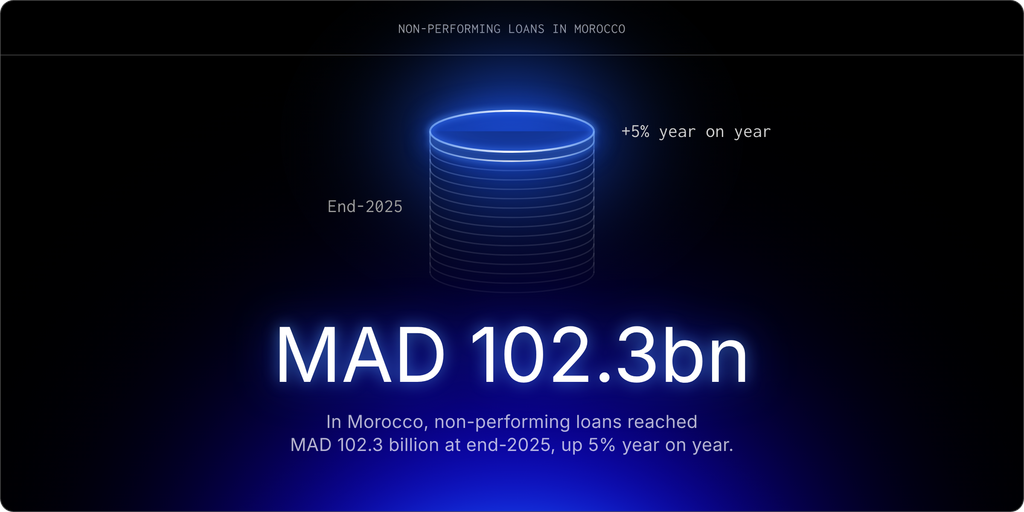
The figures highlight the scale of the challenge that banks are facing. At the end of 2025, non-performing loans on Moroccan banks’ books totalled 102.3 billion dirhams, up 5% year on year. This accounted for 8.3% of total loans, according to Bank Al-Maghrib’s annual banking supervision report. In Nigeria, non-performing loans made up 7.51% of total loans at the same date, above the central bank’s 5% prudential benchmark.
More is at stake, however, than simply the amount that banks need to recover. Losses in credit impact their bottom line and can weaken capital, potentially impacting the ability to finance new projects.
There’s an operational cost to non-performing loans, too. Following up on cases, verifying information and coordinating work all take up staff time. Inconsistent reminders or advice that overlooks a borrower’s circumstances can strain their relationship with the bank. If borrowers have to explain their situation each time they speak to someone, they may lose confidence in the bank’s ability to help.
Financial institutions must manage loans where borrowers are already struggling to make repayments, while at the same time identifying early signs of rising risk elsewhere in their portfolios.
Why does provisioning lag behind credit risk?
Provisioning begins at loan origination. Under IFRS 9, the international accounting standard for financial instruments, a bank recognizes expected credit losses before a borrower defaults or the debt collection process begins. As a result, the assessment will change as risk evolves. A loan might move to a different stage when its credit risk increases significantly, and then again if it goes into default. This classification of loans by risk level determines how banks account for them.
The difficulty arises when the required information is scattered across different paper files, spreadsheets and disconnected systems. The collections team may already know about a late payment before the bank’s risk assessment reflects it. Re-entering data increases the likelihood of errors, while incomplete data or data updated at different times can lead to comparable situations being handled differently.
Fragmentation also makes it harder to get a full picture for each client. When a borrower has multiple loans, the bank must be able to reconcile the borrower’s obligations and the associated collateral to assess its overall risk exposure. A case-by-case analysis risks overlooking these connections.
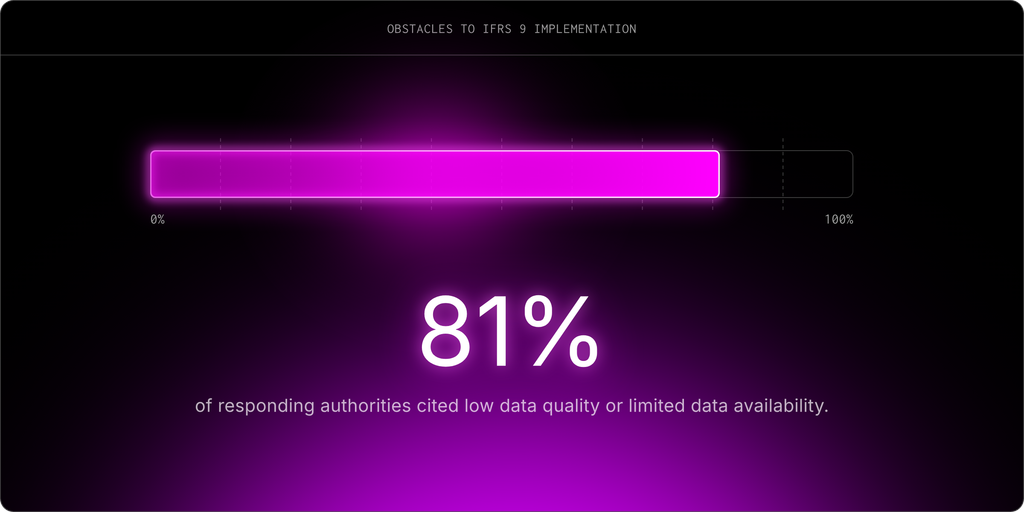
In a 2020 World Bank survey conducted in 91 countries, 81% of the authorities that responded cited poor data quality or limited data availability as among the main obstacles to the implementation of IFRS 9.
These challenges may, however, persist even when collection processes are already digitized. While the information is available in a system, its transfer to the classification and provisioning processes remains manual. As volumes increase, reconciliations and verifications consume more resources.
This creates a growing gap between the borrower’s actual situation and how it is reflected in assessments. Provisions may remain insufficient for too long, then require significant catch-up adjustments once the deterioration in risk is finally recognized.
| Issue | With fragmented processes | With shared, up-to-date data |
| Risk monitoring | Information can take time to reach the relevant teams. | Changes in payment behavior are taken into account more quickly. |
| Customer overview | A loan-by-loan assessment can obscure links between loans and collateral. | Teams have a fuller picture of the borrower’s obligations. |
| Staging and provisioning | Incomplete information can lead to inconsistent treatment and delay adjustments to provisions. | Teams apply staging rules more consistently and use up-to-date data for provisioning. |
| Operational workload | Re-entering, reconciling and checking data take up staff time. | Automation can free up time for cases that require staff judgement. |
| Customer relationships | Scattered information can lead to inconsistent reminders. | A shared understanding of the customer’s circumstances helps teams tailor their conversations. |
Using collections data for better provisioning
To reduce the time it takes for missed payments to show up in the bank’s assessments, risk, finance and collections teams need access to up-to-date repayment data.
A modern debt collection platform already aggregates parts of the relevant information, including payment history, payment behavior, and data on customers and their accounts. Available as soon as the first payment is missed, this data can help detect a significant increase in risk earlier, even before the loan is classified as defaulted. To refine this detection, however, it must be cross-referenced with other indicators, including credit data, collateral and economic outlooks.
Consider the case of a customer who repeatedly misses payments on one loan while continuing to make payments on others. By cross-referencing the customer’s payment history with data on their loans and collateral, credit risk teams can review all of their financial obligations and assess whether the risk has increased, in accordance with the bank’s applicable rules. This shared view also helps to tailor interactions with the customer and discuss repayment terms.
Risk-based classification tools can then help apply validated rules consistently and update loan loss provisions based on each loan’s current risk category. The goal is to more quickly account for changes in payment behavior that may signal an increase in risk.
Automating data transfers and checks helps banks handle more cases and gives staff more time to review those that require individual judgment. When estimating expected credit losses, banks consider collections data alongside other credit information, economic forecasts and the judgment of their credit risk staff. These estimates also cover loans on which borrowers are still making payments on time.
A bank that already uses a modern collections platform may be able to connect it to the tools it uses to classify loans and calculate provisions without replacing its core banking system.
SBS brings collections, staging and provisioning into one ecosystem
SBS Collection Management integrates Default Management and Provision Management within a single ecosystem. Together, these components allow banks to use the same data to classify loans by risk level, determine provisions and manage collections. By drawing on operational data when assessing credit risk and accounting for expected credit losses, banks can classify loans more consistently, make better-informed provisioning decisions and coordinate their response when borrowers struggle to repay.
FAQs on collections data and loan loss provisioning
No. Under IFRS 9, provisioning begins when a bank originates a loan, before any default or collection activity. The bank then updates its estimate of expected credit losses as risk changes, including for loans that are not in collections.
A borrower’s arrears history and payment patterns can shed light on repayment difficulties. Banks can use this information alongside credit and collateral data to assess risk and update provisions. Collections data complements other available information, the economic outlook and the professional judgment of those assessing the loans.
Information may already be available in a collections system but take time to reach those responsible for loan classification and provisioning. When staff have to transfer data manually, re-entering and checking it can delay updates to classifications and provisions as risk changes.
Not necessarily. If a bank already has a modern platform, updating its existing system may be enough to connect loan classification, provisioning and collections more closely. SBS Collection Management integrates Default Management and Provision Management within a single ecosystem, allowing banks to use the same data across all three processes.