

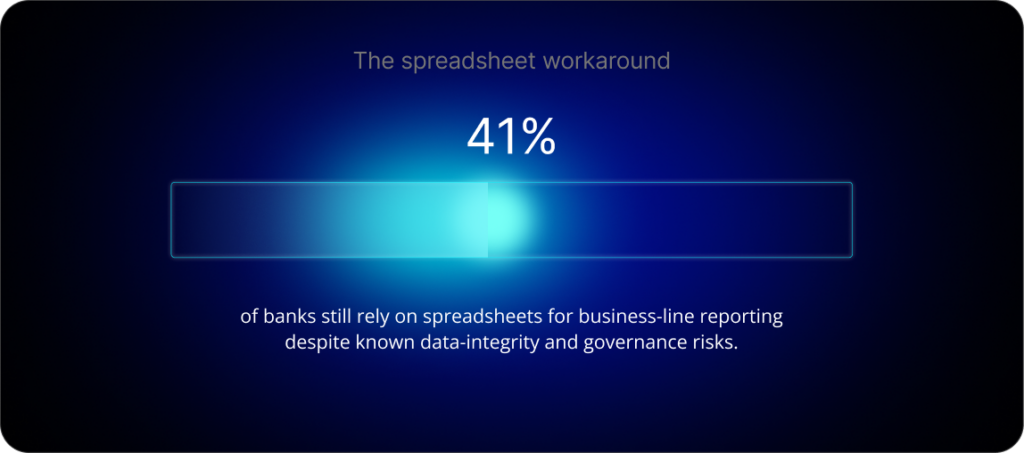
- 41% of banks use spreadsheets to manage data used by business lines.
- One-third of bank leaders cite an inability to use data effectively as a top technology challenge.
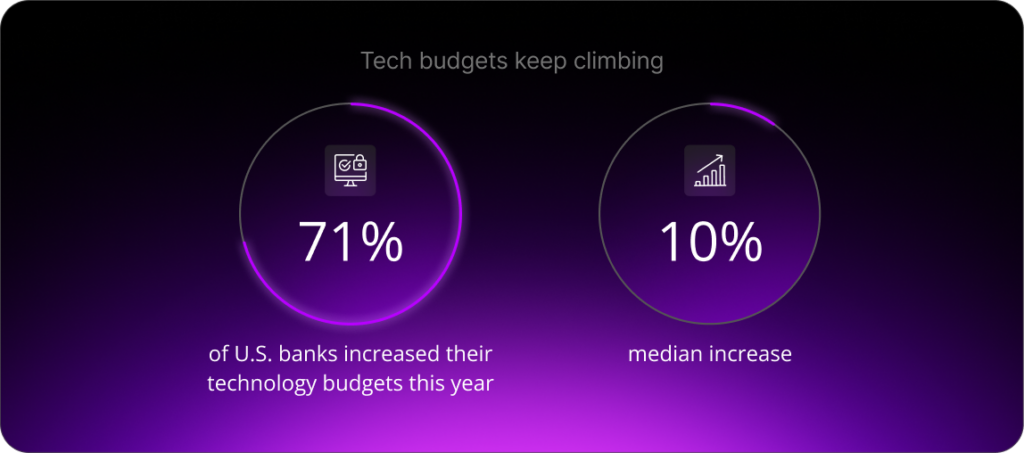
- 71% of banks increased their technology budgets this year, with a median increase of 10%.
In 2025, data is no longer a differentiator in lending. Everyone has it. The real question is whether lenders can use it quickly, confidently, and without friction. For many floorplan and wholesale lending teams, the honest answer is still “not really.” Despite years of investment in loan management systems, reporting often remains locked behind vendor queues, IT workstreams, or complex third‑party tools. Business users may technically own the data, but practical, self-service reporting (the ability to pull answers on their own) is still surprisingly difficult. And that gap matters more than many organizations realize.
Reporting is how the business thinks
Reporting is often treated as a downstream capability as something layered on once lending operations are live. In a world where business moves fast, self-service reporting is central to a lender’s success. Leadership relies on it to understand portfolio performance and enable them to make more informed decisions to help achieve business objectives. Credit and risk teams depend on it to spot early warning signs, as well as identify and prevent loss. Operations teams use it to manage throughput and efficiency. When answers are slow or incomplete, decisions are delayed, and delay introduces uncertainty.
This challenge is widespread, and recent U.S. industry research shows that many banks still struggle to turn data into usable insight, with 41% having a continued reliance on spreadsheets to manage data used by business lines, despite well‑known risks around consistency, governance, and control.
When access to insight depends on a few individuals
With a third of leaders struggling to use data effectively, reporting expertise is concentrated in a small group of senior contributors. This is not because it should be, but because systems are too complex for broader use. When experienced credit officers, risk leaders, or operations managers are responsible for assembling reports simply because they are “the only ones who know how,” the organization pays twice. First, through inefficiency. Second, through lost opportunity.
These staff have unique expertise that would be better deployed elsewhere, focused on judgment, strategy, and customer outcomes instead of administrative work. When business insight is bottlenecked through a handful of people, the lender loses the ability to respond proactively to emerging risks and opportunities.
What self‑service reporting really means
Self‑service reporting is often misunderstood, and it is not about adding more dashboards or exporting more data. It is about enabling business users to build and adjust reports without filing IT tickets, save and reuse templates, and answering follow‑up questions immediately, without waiting for a development cycle. This level of access fundamentally changes how organizations operate. Reporting moves from a periodic exercise to a continuous capability, embedded in daily decision‑making and empowering businesses to quickly identify market changes and opportunities to shift and refocus on growth and efficiency.
Why traditional approaches fall short
Most lenders still rely on one of three reporting models.
Some are dependent on vendor‑controlled reporting, where requests are submitted and fulfilled days or weeks later. Others rely on IT‑built reporting, which relies on internal teams to design and maintain custom queries. Many attempt to bridge gaps with third‑party BI tools layered on top of core systems. This often sounds like an ideal solution, but it requires data pipelines, governance frameworks, and ongoing maintenance.
Technology spending continues to climb, 71% of U.S. banks increased their tech budgets this year, with a median increase of 10%. Yet much of that investment goes toward working around limitations in core platforms rather than advancing new capabilities.
There are also less visible impacts: slower access to data leads to slower decisions. Teams default to spreadsheets and one‑off exports, creating version‑control issues. During audits or examinations, institutions often scramble to reconstruct what happened and why. Over time, these inefficiencies compound, costs rise, and opportunities are missed.
Why self-service reporting matters more now
The challenge of data access is not just about reporting. It is a signal of broader system maturity. Industry research points to data readiness as a prerequisite for modern lending capabilities. Those who struggle to scale advanced analytics or AI hit barriers not because of model limitations, but because of fragmented, poorly governed data foundations.
If a platform cannot support timely, reliable reporting, it is unlikely to support modern workflows elsewhere. Without a coherent data strategy, lenders will be poorly positioned to take advantage of the AI‑driven capabilities expected to differentiate institutions over the next three to five years.
What sustainable self-service reporting looks like
A modern floorplan or wholesale lending platform should treat reporting as a core capability instead of a separate BI project. This involves being embedded, purpose‑built reporting that reduces dependency on internal IT build cycles, vendor report backlogs, and fragile third‑party data pipelines. This does not require a wholesale transformation overnight. Many institutions are prioritizing specific use cases, such as credit monitoring, risk oversight, operational visibility, and building momentum over time.
Lenders evaluating their reporting capabilities often start with a few foundational questions.
- Which decisions matter most and what data is needed to support them?
- How well does reporting flow from data to decision today?
- Can business users access and adapt reports independently?
- Is reporting embedded and purpose‑built, or dependent on bolt‑on tools?
The answers quickly reveal where friction and opportunity lie.
How SBS and Vero can help
Lenders are turning to software partnerships that combine deep lending expertise with modern data and reporting foundations. A good example of this is SBS Wholesale Financing with Vero. Rather than positioning reporting as an add‑on, the solution is designed to support embedded access to operational and portfolio data, helping business users engage directly with insight while reducing reliance on bespoke IT development.
The value is not just cost avoidance, but a wider investment in operational maturity, where reporting speed and reliability become a force multiplier across credit, operations, and leadership. In a market where data is abundant, the real differentiator is no longer whether institutions have it, but whether they can actually use it.
Questions and answers
Self-service reporting lets business users build and adjust reports without filing IT tickets, save and reuse templates, and answer follow-up questions immediately, without waiting for a development cycle. It is not about adding more dashboards or exporting more data; it moves reporting from a periodic exercise to a continuous capability embedded in daily decision-making.