
#Core Banking
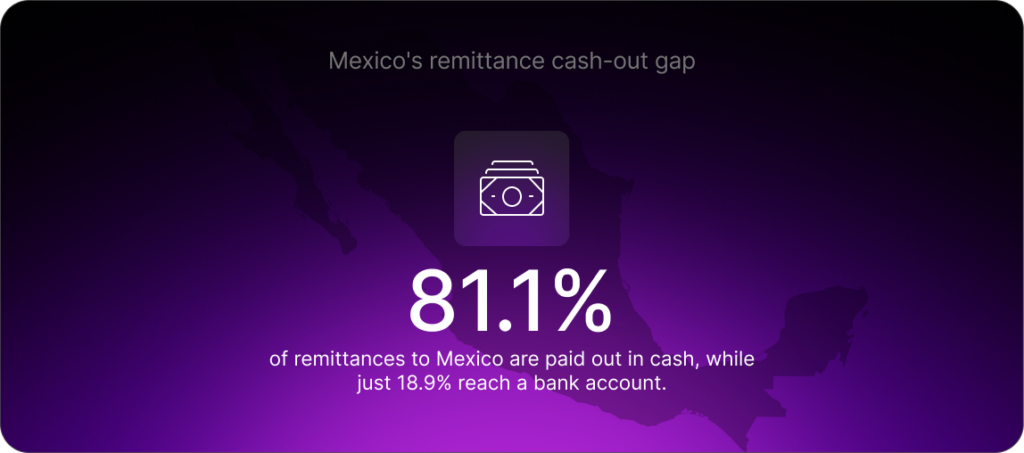
- Most transfers are sent electronically from the US but 81.1% are paid out in cash, setting off a digital finance race.
- Digital payments and remittances was Mexico’s fastest-growing fintech segment in 2025.
- Just 63% of adults aged 18 to 70 have at least one formal savings account but mobile wallets are on the rise.
Remittances have long been a financial lifeline for the families of millions of Mexicans working in the US, driven by decades of migration that has transformed the two countries into the world’s biggest payment transfer corridor. But while 99.1% of remittances to Mexico are sent electronically from the US, 81.1% are paid out in cash through non-bank outlets and just 18.9% reach a bank account, according to data compiled by BBVA Research and Banxico, the central bank. This has set off a digital finance race to intercept the money before it is withdrawn in cash, with mobile wallets, neobanks and global players such as Revolut jostling for a slice of the action in a country where 85.2% of adults use physical money as their primary payment method.
According to the International Organization for Migration’s World Migration Report 2026, Mexico is the world’s second-largest remittance recipient country, behind only India. Since 2010, remittances to Mexico have grown from US$22.77 billion to US$67.64 billion in 2024, the report’s data shows. Meanwhile, the US is the world’s top remittance-sending country, rising from US$50.53 billion in 2010 to US$103.18 billion in 2024.
In our Banking is Local series, we explore how the world’s largest remittance corridor, shaped by decades of migration and the scars of the 1994 peso crisis, became a defining local force in Mexico’s digital transformation.
Why are remittances to Mexico still paid out in cash? The legacy of the Tequila Effect
The Mexican government’s sudden devaluation of the peso against the US dollar in December 1994 sparked an economic crisis. Known as the “Tequila Effect,” it spread across Latin America and caused a flight of capital from Mexico as the currency’s value plummeted, leading to a recession and a sharp spike in inflation.
While Mexico underwent monetary reforms and received a US$50 billion bailout, led by the US and the International Monetary Fund, the shadow of the crisis is evident today. The banking sector remains cautious, with lending rates among the highest in Latin America at about 25% and SMEs struggling to borrow.
In the years since the peso crisis, foreign banks have moved into Mexico and now hold 55% of the country’s bank assets, led by Spain’s BBVA and Santander. According to Latinometrics, the top six banks in Mexico as of March 2025 are:
| Bank | Assets (US$) | Market share | Country |
| BBVA | $162 billion | 21.8% | Spain |
| Santander | $96.5 billion | 13% | Spain |
| Banorte | $93.5 billion | 12.5% | Mexico |
| Banamex | $52.8 billion | 7.1% | Mexico |
| HSBC | $44.6 billion | 6% | UK |
| Scotiabank | $43.6 billion | 5.8% | Canada |
Despite the dominance of foreign banks, just 63% of adults aged 18 to 70 have at least one formal savings account, while 76.5% of the population have at least one financial product, a 2025 survey by Mexico’s National Institute of Statistics and Geography found.
The study also noted that the proportion of people with accounts opened online or through non-banking apps has increased by 7.6 percentage points since 2021.
Are digital payments taking hold in Mexico?
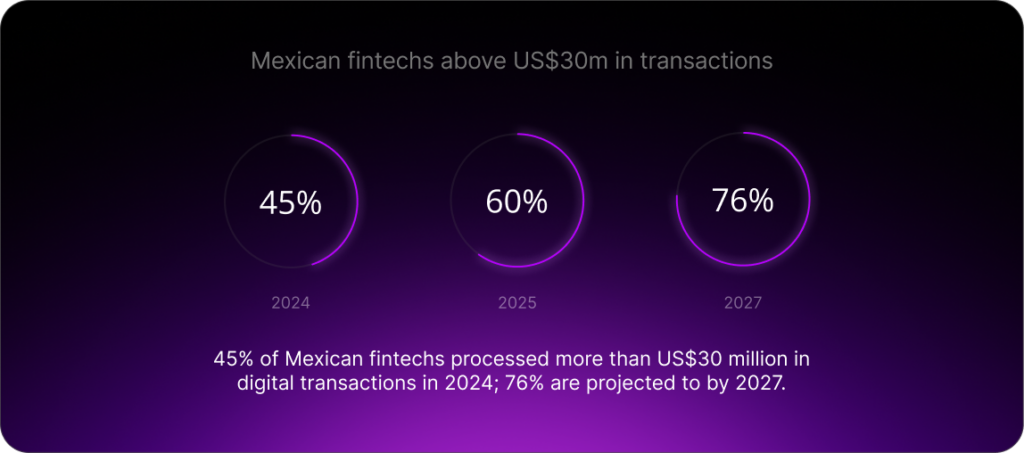
Digital payments and remittances to Mexico made up the country’s fastest-growing fintech segment in 2024, according to a report by Finnovista, Mastercard and Galileo. The research found that digital payment solutions in Mexico continue to increase, with 45% of fintechs processing more than US$30 million of digital transactions in 2024. That figure is forecast to exceed 60% in 2025 and 76% in 2027, it noted.
The use of cash is also dropping, decreasing from 76% of point-of-sale transactions in 2014 to 35% in 2024 and is projected to drop to 31% by 2030, according to a report by Quinto Poder.
“Mexico has transitioned from a predominantly cash-based economy to a more robust and dynamic digital ecosystem … thanks to technological advancements and changes in consumption patterns,” Quinto Poder states in the report.
Meanwhile, El Economista newspaper reported that digital wallets are now used by more than 50% of mobile users, citing Research and Markets estimates that the prepaid card and digital wallet segment will continue to grow at an annual rate of 14.3%.
How digital remittances to Mexico are widening the corridor
The adoption of mobile wallets in Mexico has accelerated under President Claudia Sheinbaum’s Plan Mexico, an initiative aimed at growing the economy that includes digitalization and financial inclusion. It is also being driven by Mexico’s 2018 Fintech Law, one of the region’s first comprehensive frameworks, that regulates 89 licensed fintech firms, as well as the switch to contactless payments during the pandemic.
In January this year, Revolut launched full banking operations in Mexico, marking its first bank outside Europe as it seeks to become a key player in the country’s remittance corridor.
“We have arrived to revolutionize banking in Mexico,” Juan Guerra, CEO of Revolut Bank, said at the time. “Finally, there is an elegant digital alternative to traditional institutions, offering everything from high-yield savings to seamless international transfers and tools for the whole family. Revolut Bank S.A. has launched to help people in Mexico get more out of their money, and this is only the beginning,” Guerra added.
Other players chasing Mexico’s remittance cash-out include crypto exchange Bitso, which also offers services such as international money transfers, and Clip, a digital payments fintech that focuses on SMEs.
However, homegrown unicorn Banco Plata – with a recent valuation of US$5 billion and more than 3 million customers – could give Revolut a run for its money after receiving a full banking license in February this year, allowing it to include cross-border transfers in its service offerings.
The strategic value of remittances to Mexico is shifting. The winner will not be whoever moves money across the border most cheaply, but whoever keeps the customer once it lands in Mexico. Turning a one-off cash-out into an ongoing relationship means capturing not just a transfer fee, but the account, the savings and the lending that follow.
For banks, that reframes the stakes:
- Remittances become a customer-acquisition channel, not just a payment product.
- The digital wallet, not the cash-out counter, becomes the first banking interaction.
- Competition moves from transfer fees to the lifetime value of the customer behind each transfer.
The surge in digital wallets and neobanks marks the beginning of the battle as remittance to Mexico continue to attract fintechs looking to transform the country’s distinct cash-out mindset into an on-ramp to digital finance. Whoever captures the money before it turns back into cash is likely to win, but whether that will be a local fintech or a global player remains to be seen.
For more expert content on industry outlooks and innovation, subscribe to our newsletter or visit our Insights page.
Q&A: Key facts about remittances to Mexico
It is the world’s largest remittance corridor. Mexico is also the world’s second-largest remittance recipient country, behind only India. Since 2010, remittances to Mexico have grown from US$22.77 billion to US$67.64 billion in 2024, while the US is the world’s top remittance-sending country.
While 99.1% of remittances to Mexico are sent electronically, more than 80% are withdrawn in cash and just 18.9% reach a bank account. Cash is preferred in daily life, with 85.2% of adults using physical money as their primary payment method.
Revolut launched banking services in Mexico this year, while local fintechs include crypto exchange Bitso, SME-focused payments firm Clip and Banco Plata, which was awarded a full banking license in February.