
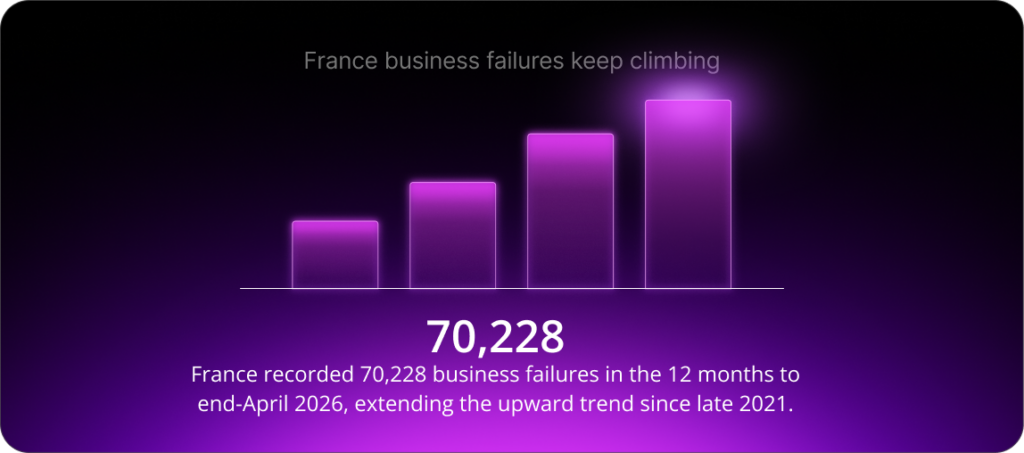
- France recorded 70,228 business failures in the 12 months to the end of April 2026.
- A well-designed early warning system can reduce loan loss provisions by 10% to 20%.
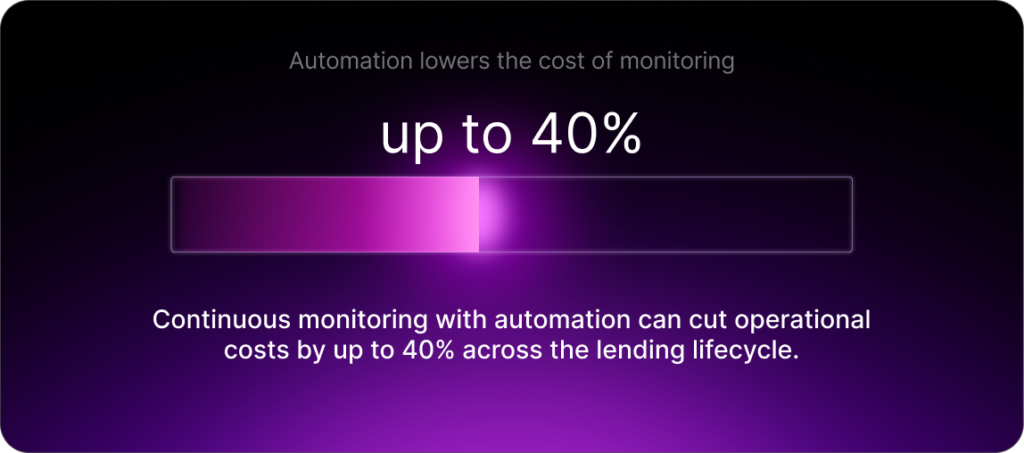
- Continuous monitoring delivers up to 40% lower operational costs through automation.
For decades, credit risk in France has been managed through periodic reviews, often centered on an annual assessment of the borrower’s financial position, a snapshot taken at set intervals rather than continuous monitoring of borrower health. This model gave lenders a structured way to reassess exposure, update risk ratings and identify signs of financial deterioration. But that model was designed for a more stable economic environment, where material changes in a company’s financial health typically emerged over months or years rather than weeks.
Today, businesses face a more volatile operating environment. Inflationary pressure, rising financing costs, late payments, sector disruption and weaker demand can all affect a company’s liquidity in a matter of weeks rather than months. This is reflected in the continued rise in corporate insolvencies. By the end of April 2026, France had recorded 70,228 business failures over the previous 12 months, continuing the broader upward trend that began in late 2021. For banks, this creates a fundamental challenge. Borrower risk is becoming more dynamic, yet many institutions still rely on periodic reviews to assess it. The result is that financial deterioration can develop unnoticed between review cycles, leaving lenders with fewer opportunities to intervene before problems escalate.
If banks want to identify emerging risks earlier, acting before they become defaults, they need a different approach to credit monitoring.
Why traditional credit monitoring is struggling to keep pace
Blind spots between reviews
The first problem with traditional credit monitoring is the blind spots that occur between reviews. A lot can happen in 12 months. A company can lose a major customer, face late payments from its own clients, experience margin pressure, suffer a sector shock or start using overdraft lines more heavily. None of this necessarily appears clearly in annual accounts until months later.
In other words, the annual review captures credit risk at fixed points in time, while borrower risk now moves continuously. The longer the gap between reviews, the greater the risk that emerging problems will go unnoticed.
Looking backward instead of ahead
Traditional reviews are inherently backward-looking. They explain how a borrower has performed, rather than how its risk profile is changing. By the time deteriorating liquidity, weaker profitability or rising leverage appears in formal financial statements, the borrower may already be close to distress.
This is particularly true for SME and ETI portfolios, where businesses can deteriorate quickly in response to changing market conditions. For lenders, that means the first clear warning of worsening credit quality may come only after valuable opportunities for early intervention have already been lost.
Managing damage rather than preventing risk
Traditional monitoring can push banks into a reactive position. Escalation often happens when there is already a visible credit event, such as a payment delay, excess, covenant breach, arrears or restructuring request. At that point, the bank is managing damage rather than preventing risk.
That means higher provisions, more recovery work, more pressure on relationship teams and fewer options to support the borrower before the situation worsens. A well-designed early warning system, by contrast, can reduce loan loss provisions by 10% to 20% and lower the amount of regulatory capital tied up by around 10%.
Labor intensive
Traditional credit monitoring is resource-intensive. Portfolio monitoring depends heavily on relationship managers and credit teams spotting the right signals at the right time. That becomes difficult when they are responsible for hundreds of borrowers across multiple sectors. Important weak signals can be missed. At the same time, credit managers spend too much time on low-value monitoring and administrative reviews, instead of focusing on targeted intervention.
The European Central Bank made a similar point in 2025, arguing that effective SME crisis management requires robust early warning systems based on diversified information sources, high levels of automation, customer behavior signals and external data.
Regulatory expectations are changing
Finally, there is a regulatory dimension. The EBA Guidelines on loan origination and monitoring, applicable since June 30, 2021, expect institutions to maintain robust monitoring frameworks throughout the life of a loan. In particular, they state that institutions should “develop, maintain and regularly evaluate relevant quantitative and qualitative EWIs,” supported by appropriate IT and data infrastructure.
Effective post-origination monitoring is therefore no longer simply a matter of operational best practice. Lenders must also be able to demonstrate that emerging risks can be identified, escalated and acted on in a timely and traceable way.
Continuous monitoring: the alternative to annual reviews
Unlike periodic reviews, continuous monitoring provides an ongoing view of borrower risk throughout the lifecycle of the loan. Rather than waiting for the next annual assessment, it captures changes in borrower health as they occur, allowing lenders to identify emerging risks earlier and respond before they become payment incidents.
This is made possible through automated early warning systems. Instead of relying primarily on annual financial statements, lenders can combine a wide range of internal and external signals, such as account behavior, payment patterns, sector developments and external data, to build a more current picture of borrower health.
Crucially, continuous monitoring is not about generating more alerts. It is about generating the right ones. Early warning models identify patterns associated with future borrower difficulty and notify relationship managers only when predefined thresholds are crossed. As a result, credit teams can focus their attention on the borrowers most likely to require intervention.
This changes the role of the credit manager. Instead of spending time searching for emerging risks, they can concentrate on understanding them and deciding how best to respond. In doing so, continuous monitoring shifts credit management from a reactive process – i.e., responding to missed payments and covenant breaches – to a proactive one built around earlier intervention and better prioritization.
| Traditional credit monitoring | Continuous monitoring |
| Periodic reviews, typically annual | Ongoing monitoring throughout the life of the loan |
| Based primarily on historical financial data | Uses automated data and indicators such as declining cash flow, lower account balances, rising debt and payment delays. |
| Captures risk at fixed points in time | Captures changes in borrower health as they occur |
| Often reacts to payment incidents or covenant breaches | Identifies emerging risks before they become defaults, such as liquidity stress, declining profitability, payment anomalies and covenant deterioration. |
| Resource-intensive manual reviews | Alerts relationship managers only when action is needed |
Supporting proactive credit management with SBS Lending Suite
Implementing continuous monitoring can be challenging. The issue is not simply whether banks can access more data, but rather turning that data into timely, consistent and actionable risk insight.
Done successfully, this can have a measurable impact on cost of risk, portfolio quality and operational efficiency, including tangible outcomes such as reduced loan loss provisions (typically 10–20%), up to 40% lower operational costs through automation, improved time-to-detection of credit deterioration, and faster, more consistent credit decisions across portfolios.
First, the data needed for continuous monitoring is often fragmented across multiple systems. Lending, servicing, collateral, collections, risk and external data sources may all hold relevant information. SBS Lending Suite addresses this challenge by unifying these data flows across the lending lifecycle, providing a single operational view of borrower exposure. With a unified view, banks can gain comprehensive and real-time understanding of borrower health, ultimately improving portfolio quality and increasing operational efficiency.
Second, identifying risk is only half the challenge. Banks must also translate warning signals into timely action. If alerts are disconnected from operational workflows, they can create more noise than value. Credit teams need clear prioritization, escalation processes and decision support to focus on the most material exposures, improving early intervention and supporting better risk-adjusted decisions.
Third, continuous monitoring must scale across large portfolios without overwhelming credit teams. More data should not mean more manual work. Automation and AI are essential to process signals efficiently, identify meaningful changes and support credit managers with relevant context. When effectively implemented, these capabilities help reduce manual portfolio review effort and improve the speed and consistency of risk detection.
This is where modern lending infrastructure becomes critical.
By working with an experienced partner like SBS, lenders can transition toward a more connected and proactive model of credit management. SBS Lending Suite brings together data, workflows and decision-making across the lending lifecycle, helping institutions move beyond fragmented credit operations and toward a fully integrated risk management framework.
Its modular architecture allows banks to modernize progressively, rather than through a single large-scale transformation. This matters for institutions that need to strengthen monitoring, improve operational efficiency and meet regulatory expectations while protecting existing processes.
SBS Lending Suite also supports automation and AI-driven processes designed to improve efficiency, risk management and operational control. By connecting data and workflows across credit operations, it helps lenders transform risk signals into action and support more consistent portfolio management. Continuous monitoring offers a more effective way to manage credit risk, but its value depends on implementation. Lenders need the ability to consolidate data, prioritize warning signs and act at scale. In a more volatile credit environment, the institutions that succeed will be those that combine earlier risk detection with the operational infrastructure needed to respond.
Reach out to a member of our team today to discover how SBS Lending Suite can help your organization modernize credit management and build a more proactive approach to credit risk.
Q&A: Questions on continuous monitoring
Annual credit reviews provide a structured assessment of borrower risk, but they evaluate credit exposures at fixed points in time. In a more volatile economic environment, a borrower’s financial position can change significantly between review cycles, leaving lenders with limited visibility into emerging risks until they become more difficult to address.