
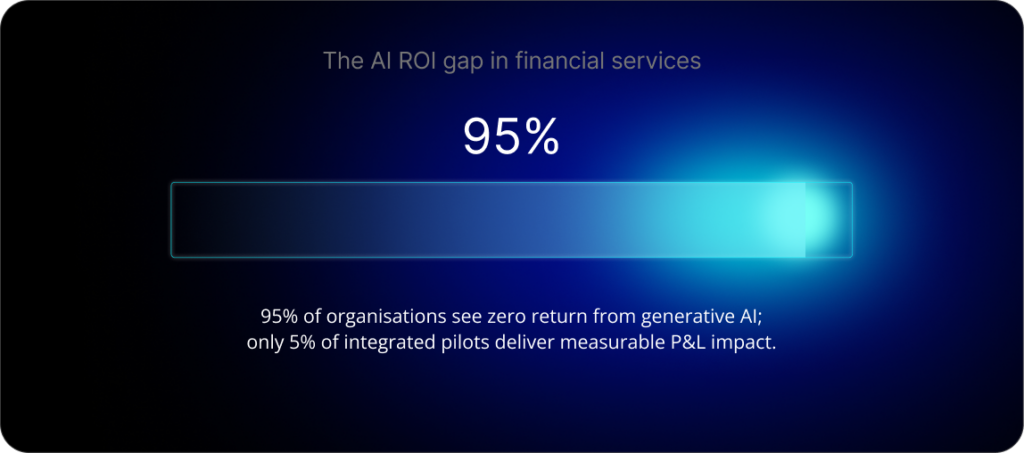
- 95% of organisations are seeing zero return from generative AI, and just 5% of integrated pilots deliver measurable P&L impact.
- 72% of chief executives said they are now the main decision-maker on AI, twice as many as in 2025.
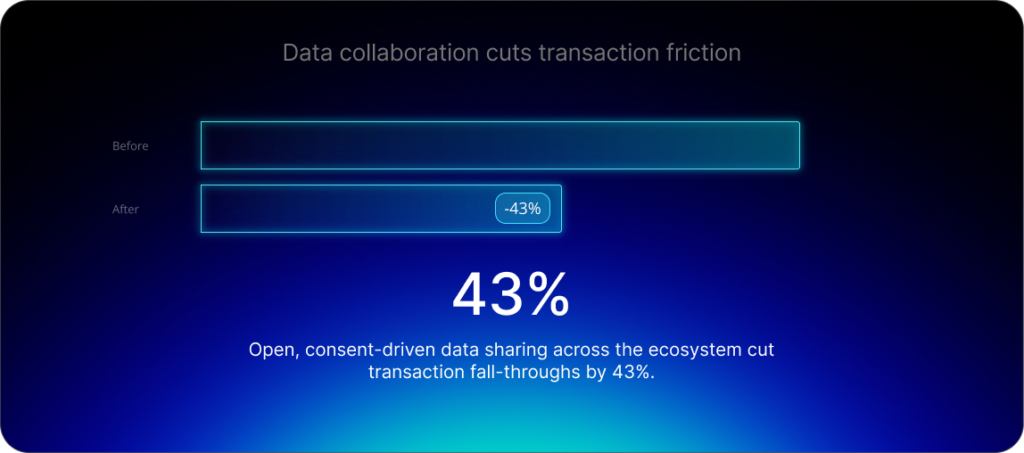
- An LMS-led industry pilot cut transaction fall-throughs by 43%.
From responsible AI and data quality to open collaboration and customer innovation: the themes driving financial services forward. Three messages ran through every conversation of the day. AI succeeds or fails on the quality of the data beneath it, and on the willingness to share it across the ecosystem. Transformation pays off when it starts from customer problems rather than technology opportunities. And the advantage will go to the financial services institutions that scale AI responsibly, embedding governance, explainability, and human oversight from the start.
On 16 June 2026, financial services executives, technology leaders, and practitioners gathered for SBS Connect London. Across keynotes, panels, and conversations, ten themes recurred. These are the priorities shaping the industry’s future.
1. Data quality, not technology, is the real prerequisite for AI in financial services
AI initiatives do not fail because the technology is wrong. They fail because the underlying data is ungoverned, inaccessible, or untrustworthy. According to the MIT NANDA Initiative’s 2025 report, 95% of organisations are seeing zero return from generative AI, and just 5% of integrated pilots deliver measurable P&L impact. The first question before any AI program is not which model to use but whether the data those models rely on is accessible, governed, and fit for purpose.
2. AI reshapes roles, not human value
The narrative that AI is primarily a headcount reduction tool was firmly rejected. BCG’s 2026 analysis of 165 million US jobs found that most roles will remain as AI is deployed at scale, though 50–55% of them will be substantially reshaped, with tasks shifting towards higher-value work. The conversations about retirement plans, business ambitions, and complex financial decisions are not reducible to automation. Institutions managing this transition most effectively are treating it as a workforce strategy question, investing in redeployment pathways and communicating transparently with their people.
3. Moving from pilots to production
A clear divide is emerging between the institutions still running pilots and the smaller number moving AI into production at scale. The latter are accumulating structural cost advantages as a result. BCG’s 2025 AI at Work survey of over 10,600 workers found that value materialises when organisations go beyond tool deployment and reshape workflows end to end. The governance framework that makes that possible has three layers: governed data as the foundation; consistent evaluation of AI outputs with drift detection; and human-in-the-loop oversight for decisions with regulatory or customer impact.
4. Customer centricity must drive transformation
Start with the customer need, not the technology opportunity. The tendency to treat transformation as an objective in its own right was consistently challenged. The most powerful examples shared during the day were products built around real customer pain points: removing friction, simplifying complexity, and improving access. Speed, efficiency, and operational improvements followed as results of thoughtful design, not as primary goals. Transformation should be measured through customer outcomes, not technology roadmap milestones.
5. Specialist finance markets are at a structural turning point
Across specialist and asset finance markets, a convergence of pressures is reshaping competition: new entrants unburdened by legacy systems, margin compression, evolving asset classes, and rising customer expectations. In BCG’s AI Radar 2026 survey, the leading companies allocate more than 80% of their AI investments to reshaping core functions and inventing new offerings. In markets where financing rates and operational costs are broadly similar, speed and convenience are becoming the primary differentiators. The window to build a structural AI advantage is narrow.
6. Explainability and sovereignty are non-negotiable
In financial services, AI must be deterministic, auditable, and explainable. In June 2025, the FCA and the Information Commissioner’s Office jointly announced plans for a statutory code of practice covering firms that build or deploy AI in automated decision-making.
Model sovereignty is an equally pressing concern, and the Bank of England’s Financial Policy Committee has flagged systemic risks arising from AI and cloud concentration, which it continues to monitor as a financial stability issue. Drift adds a further obligation: AI outputs accurate at deployment can degrade over time, and active monitoring is not optional.
7. Long-term partnerships outperform transactional vendor relationships
One of the most distinctive conversations of the day examined what a genuine technology partnership looks like over a 20-year horizon. The recurring answer came down to cultural fit, transparency, and the willingness of both parties to have difficult conversations. The capacity for honest disagreement is a feature of a strong partnership, not a risk. Institutions evaluating technology relationships should weight cultural alignment and genuine accountability as heavily as product capability.
8. Underserved customers represent one of the largest untapped opportunities in financial services
The mass market remains one of the most underserved segments in financial services, particularly customers with lower financial confidence, limited digital literacy, or more complex circumstances. AI introduces a specific risk here: models trained on historical data can inherit and amplify existing patterns of exclusion. Institutions must design AI solutions that work effectively for customers across varying levels of financial literacy, while recognising that some interactions will always require a human conversation. Getting this balance right is both a commercial opportunity and a responsibility.
9. Data collaboration across the financial services ecosystem will unlock the next frontier
Value in financial services is moving from institutions that hold data in silos towards open, shared ecosystems. Pilots built on the Open Property Data Association’s data standards show what consent-driven sharing makes possible. An LMS-led industry pilot cut transaction fall-throughs by 43%, and OPDA’s own 2025 programmes achieved contract exchange in as little as 15 days, against the 22-week average transaction time reported by CFIT. The same structural opportunity exists across lending, payments, insurance, and asset finance. The data infrastructure decisions made today determine the AI capability available in three years.
10. Change is now continuous and compounding
Financial institutions are still planning for change in waves. That model no longer reflects the environment they are operating in. The convergence of agentic AI, tokenisation, digital twins, and quantum computing within a five-year horizon is qualitatively different from any single technology shift. In BCG’s AI Radar 2026 survey of 640 chief executives, 72% said they are now the main decision-maker on AI in their organization, twice as many as in 2025.
The next 18 months are a decision point. Success will not be defined by how quickly institutions adopt new technology, but by how thoughtfully they apply it to deliver better outcomes for customers and the communities they serve.
SBS Connect London reinforced a simple but important point: technology alone will not define the future of financial services. The institutions that succeed will combine strong, shared data foundations, customer-focused innovation and responsible adoption of AI. In a world of continuous change, competitive advantage will come not from moving fastest, but from moving with purpose.
Contact a member of our team today to discuss how strong data foundations, customer-focused innovation and responsible AI can help your institution move forward with purpose.
Q&A: Questions on AI in financial services
AI initiatives rarely fail because the technology is wrong. They fail because the data underneath is ungoverned, inaccessible or untrustworthy. MIT’s NANDA Initiative found in 2025 that 95% of organisations see no return from generative AI, and only 5% of integrated pilots deliver measurable P&L impact. The first question for any AI programme is therefore not which model to choose, but whether the data it relies on is accessible, governed and fit for purpose.