

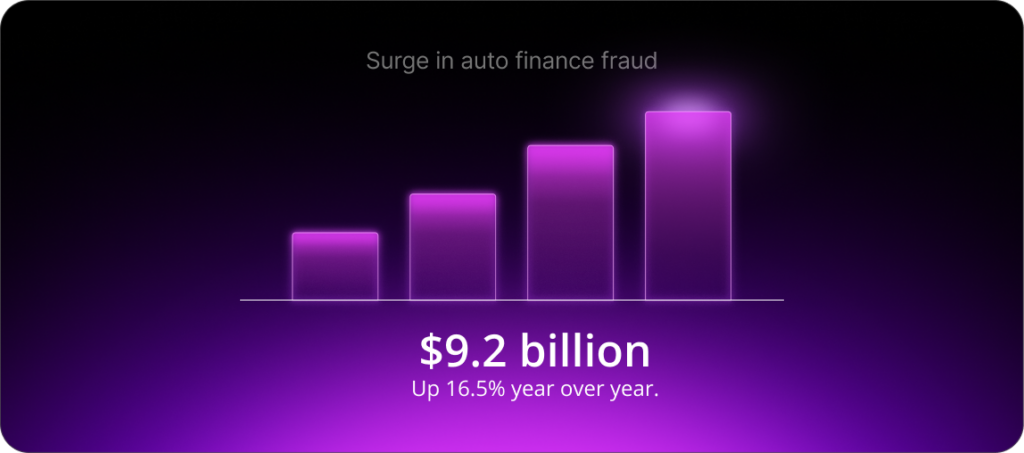
- Auto finance fraud was estimated at a record $9.2 billion in 2025, up 16.5% year over year.
- 6.6% of subprime auto loans were over 60 days past due as of January 2025.
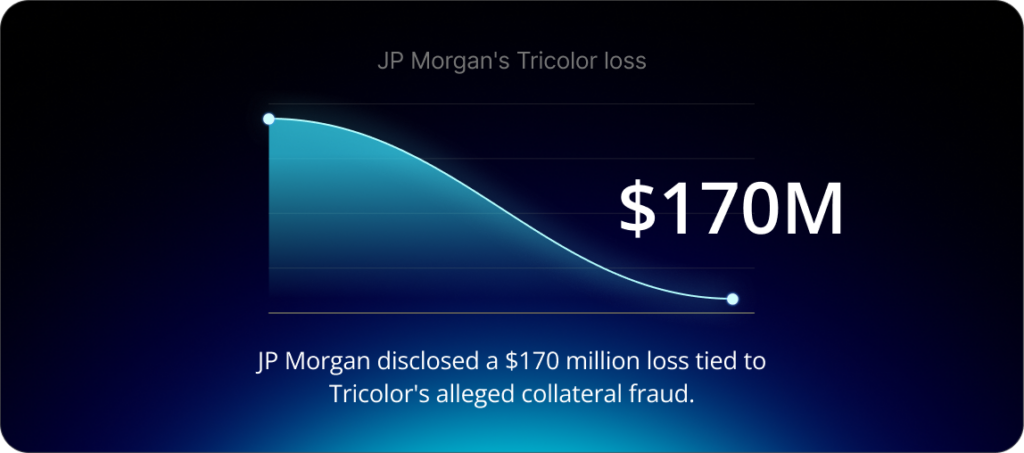
- JP Morgan disclosed a $170 million loss and Fifth Third Bancorp said it had a potential $200 million exposure to the alleged fraud scheme at Tricolor Holdings.
Specialist auto and equipment lenders in North America are navigating one of the toughest markets in years, driven by record-high loan delinquencies and a surge in fraud, pressures that are pushing audit frequency to the top of the risk management agenda. Auto finance fraud was estimated to reach a record $9.2 billion in 2025, up 16.5% year over year, according to a report by Point Predictive. First-party fraud – where borrowers or dealerships misrepresent information to lenders – accounts for 69% of the $9.2 billion fraud risk exposure, Point Predictive notes in the report. This includes vehicles that are not where borrowers say they are, inventory sold without lender knowledge, and collateral pledged to more than one financing source at the same time, it adds.
Meanwhile, US media reports that 6.6% of subprime auto loans were more than 60 days overdue as of January 2025, a figure that has since climbed to a 32-year high. For floor plan lenders and asset finance providers, these are not abstract concerns. They are showing up in audit findings and increasingly in loss provisions.
Why audit frequency between physical visits is the real risk
Most lenders rely on periodic physical audits to verify the existence, condition, and location of the collateral backing their portfolios. Field teams typically visit dealer lots, equipment yards, and borrower sites on a monthly or quarterly schedule, depending on portfolio risk profiles.
These auditors have industry knowledge and expertise that machines cannot replicate. The problem is not the quality of those audits – it is the time between them.
Physical audits are expensive, with travel, staffing, and logistical complexity dictating how often they can be carried out, particularly those distributed across portfolios covering hundreds or thousands of locations. The cost of a full-coverage physical audit program scales directly with the number of assets and the geographic spread of the portfolio. For many lenders, running audits at the frequency they would prefer is simply not economically viable, and has led to a window of opportunity for fraud and misrepresentation to take hold.
Lending without regular on-site verification exposes lenders to ghost assets, inflated valuations, and unauthorized disposals that remain invisible between inspection visits. When those gaps extend to weeks or months, a borrower with fraudulent intent has room to operate before detection becomes possible.
What happens when the gap is exploited?
Perhaps one of the best examples is the September 2025 collapse of Tricolor Holdings, serving to illustrate what the audit frequency gap costs when it is exploited systematically over a sustained period. An indictment filed by the US Attorney’s Office for the Southern District of New York in December 2025 alleges that Tricolor executives orchestrated a series of fraudulent schemes over several years that allowed the company to obtain billions of dollars from lenders by misrepresenting its loan collateral. The alleged scheme involved double-pledging by using the same loan portfolios as collateral for separate credit facilities with different lenders at the same time.
JP Morgan disclosed a $170 million loss and Fifth Third Bancorp said it had a potential $200 million exposure due to Tricolor’s alleged fraud. When lenders moved to secure collateral following the company’s bankruptcy filing, they found assets dispersed across hundreds of locations, with no clear picture of what existed, in what condition, or where.
The lesson is not that any single lender failed to conduct audits. It is that the intervals between audits, combined with limited real-time portfolio visibility, allowed the scheme to compound over time before it was detected.
How can hybrid auditing prevent fraud?
As loan delinquencies rise and fraud surges in the sector, a growing number of asset finance organizations are adopting hybrid auditing models. This is a program that combines periodic physical inspections with digital self-service tools that extend coverage between visits. While physical audit visits remain key to the success of the program, it allows lenders to focus on the highest-risk dealerships with the most complex verification needs. Between those visits, borrowers or dealer partners use self-service digital tools to submit photographic, video, and data-based verification of their inventory from their own locations at a frequency that a physical audit alone could never sustain.
This model also changes how physical audit resources are allocated. Rather than deploying field teams across a portfolio, lenders can direct visits toward locations that digital audit data has flagged as higher risk. As an SBS analysis of hybrid audit adoption shows, this approach improves risk visibility, accelerates compliance response, and reduces the overall cost of audit coverage across large networks.
Depending on the supplier, digital self-service tools can operate at a fixed cost that does not scale with portfolio volume the way a physical audit does. A lender can increase audit frequency across a much larger network without a proportional increase in expenditure.
Why audit frequency is a risk decision
For specialist and alternative lenders, audit frequency is not an operational variable; instead, it is a risk decision. A lender that audits each dealer location monthly has, at most, 30 days of undetected exposure at any given point. One that audits weekly has seven. However, always-on digital verification gives lenders near-real-time visibility.
In the current environment, the interval between audits has become one of the most material risk variables in an asset finance portfolio. Lenders treating audit frequency as a cost line rather than a risk control are carrying exposure that may not become visible until it is too late to recover it. The question is not whether to audit more frequently. It is how to build the infrastructure to do so sustainably.
How SBS can help
SBS Digital Audit provides specialist and alternative lenders with the digital self-service capability at the heart of the hybrid auditing model. By enabling dealer partners and asset holders to conduct verified digital inspections between physical visits, SBS Digital Audit extends audit coverage across the full portfolio at a fixed cost, with real-time data visibility and the insight needed to direct physical resources where they matter most.
Q&A: Key questions on hybrid auditing in asset finance
Hybrid auditing combines physical inspections with digital self-service tools, allowing lenders to maintain continuous collateral verification between field visits. This approach extends audit coverage across large portfolios at a fixed cost, improving fraud detection and risk visibility without a proportional increase in field audit expenditure. For more on how hybrid models are developing across the sector, see SBS insights on hybrid auditing in asset finance.