
- Agentic AI is moving from experiment to operating infrastructure in banking.
- 70% of banking leaders already use agentic AI through deployments or pilot projects.
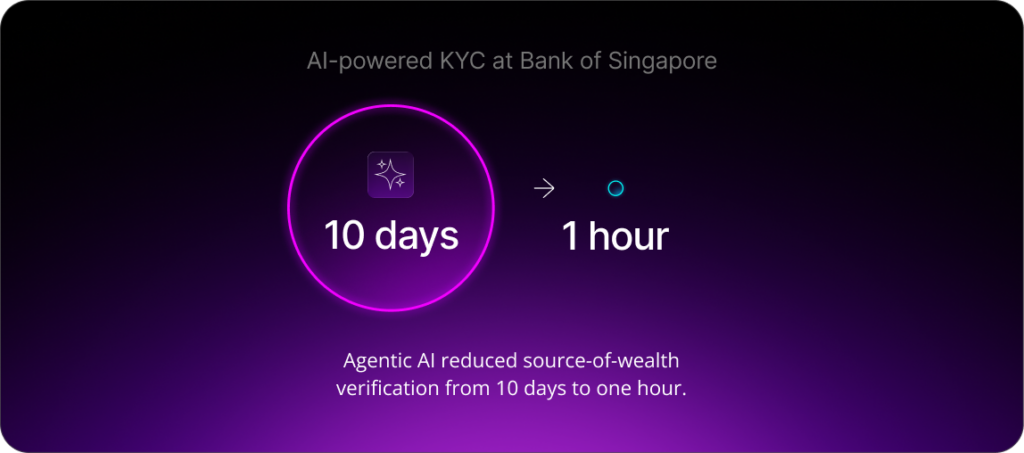
- Agentic AI reduced source-of-wealth verification from 10 days to one hour.
Artificial intelligence (AI) has long been used by the banking sector, from detecting fraud to automating operations, analyzing data, and enhancing customers’ experiences. However, the technology’s next generation, agentic AI, is transforming the sector and is beginning to move beyond the pilot stage to operating infrastructure. Agentic AI is unlocking a range of new possibilities for banks, such as allowing AI agents to act as financial advisers and negotiate loan terms, suggest financial products, analyze a customer’s financial data, or resolve disputes in real time.
According to a report by McKinsey and Company, agentic AI is capable of transforming the “value pool” of banks and financial services firms, including revenue and cost structures, customer experience, and operating models.
A 2025 study by MIT Technology Review found that agentic AI is being rapidly deployed in the banking sector, with 70% of leaders saying their firms use it to some degree, either through “existing deployments or pilot projects.”
“It is already proving effective in a range of different functions,” MIT Technology Review says in the report. “More than half of executives say agentic AI systems are highly capable of improving fraud detection and security.”
However, the technology has added new risks in the heavily regulated banking and financial services sector, where accountability and traceability are essential to maintaining customer trust, avoiding bias, detecting fraud, averting cyber threats, and ensuring regulatory compliance.

What makes Agentic AI different?
Agentic AI is designed to make autonomous decisions, pursue goals, adapt to changing conditions, and coordinate with other agents or humans with limited oversight. This is a major shift from predictive and generative AI, which typically responds to specific inputs and requests. In contrast, agentic AI systems use natural language processing, machine learning, reinforcement learning, and knowledge representation to solve multiple problems independently.
“Agentic AI can adapt to different or changing situations and has ‘agency’ to make decisions based on context,” a report by IBM notes.
This shift from passive to active intelligence means that agentic AI can answer questions, initiate tasks, reroute logic, or even identify issues that humans might miss.
Key Agentic AI trends in banking
Four key trends have emerged in the banking sector. While some banks are moving rapidly toward the deployment of agentic AI, the MIT research notes that most banking leaders believe the technology is not ready to be fully autonomous.
Trend 1: Agentic AI is moving from experiment to operating infrastructure
According to the MIT research, most banking executives report that their firms are using agentic AI to some degree, with 16% saying it is used in existing deployments and 52% saying it is being deployed through pilot projects.
One example is Wells Fargo Bank in the US, which has teamed up with Google Cloud to transform how it uses and deploys agentic AI at scale. According to a co-written blog by the two companies, Wells Fargo is an early adopter of Google Agentspace (now part of Gemini Enterprise) that will help employees “unlock significant new levels of efficiency and innovation across the entire bank.”
This includes the ability to answer, triage and summarize complex foreign exchange post-trade inquiries, as well as enabling a custom agentic AI agent that can rapidly handle contract management issues, such as identifying contracts with specific clauses and payment terms. Other uses include automating routine tasks in branches to reduce waiting times and boost customer relationships.
Trend 2: Measurable gains in compliance and back-office operations
In 2025, the Bank of Singapore rolled out an agentic AI-driven tool that automates a key part of the know-your-customer due diligence process that ensures the source of clients’ wealth and transactions. Previously, this task took 10 days but has now been reduced to an hour, according to the bank.
“With AI integrated into the source of wealth reporting process, relationship managers can shift their focus from manual documentation to meaningful client engagement and risk assessment. This not only strengthens client relationships but also maintains high standards of regulatory compliance while delivering greater value,” Kam Chin Wong, global head of financial crime compliance at the Bank of Singapore, said at the time.
Meanwhile, Canada’s Scotiabank developed AIDox in 2018 to analyze and compare documents, such as insurance letters for mortgages. Last year, it added agentic AI capabilities to AIDox, enabling it to autonomously process client emails in its commercial banking division.
“Not only can AIDox understand the complex requests emailed by commercial banking clients, but it also forwards the email to the correct team to handle it and creates a case in Scotiabank’s system for processing and fulfilment,” the bank says in an article on its website.
Trend 3: Adoption is high but value capture remains the exception
A recent podcast by McKinsey & Company discussed the pros and cons of how agentic AI is redefining banking operations. One issue the podcast guests identified was the risk of deploying narrow use cases and point solutions.
“It is very easy to pick and choose the easiest possible areas for you to go after, for example, building a chatbot for customer care, building knowledge management applications for your employees, or building a fast credit memo writer for a subset of businesses,” one guest noted.
“And then you plateau right after that. That’s essentially where you stymie the impact for AI versus driving end-to-end transformation of domains, which are business backed and have AI at the center.”
To overcome this type of scenario, HSBC “developed a mix of use cases tied to priority areas of the business, as well as a process that evaluates the value, including revenue, cost, or efficiency improvements, the company generates from building the AI system,” Ian Glasner, HSBC’s group head of emerging technology, innovation and ventures, told MIT.
Trend 4: Governance is a major challenge
Developing agentic AI within the heavily regulated banking and financial services sector is a major challenge, particularly regarding regulatory compliance, governance, data privacy, transparency, and security. According to MIT, the number one challenge 63% of respondents identified in creating value from the technology is managing governance, risk, and compliance with confidence.
“This is all about safety and making sure that our AI systems are being built in a way that we as a firm are comfortable with and within our risk tolerance,” Glasner told MIT.
Glasner adds that HSBC maintains a detailed inventory of AI systems, linked to business owners, model documentation, and risk classification to meet the bank’s risk tolerance.
However, when multiple AI agents make real-time decisions, auditing actions and accountability can become more difficult for banks to track. If AI systems cannot meet transparency and oversight standards, this could result in regulatory fines, penalties, and reputational damage, according to a report by Forbes.
While the European Union’s AI Act, the world’s first comprehensive AI law, has placed strict obligations on high-risk AI systems, it does not define or address autonomous, interacting agents, a report by HiddenLayer notes. Until tools for auditing, monitoring, and simulating multi-agent behaviors are in place and regulatory definitions catch up, banks are expected to move cautiously before fully embracing agentic AI.
What else can Agentic AI unlock?
From a customer service perspective, it could help banks provide hyper-personalized services 24 hours a day by a dedicated virtual agent that understands the context of an existing banking relationship and transaction history, according to a report by The Financial Brand.
Other examples include boosting back-office operations by automating tasks such as data entry, compliance checks, and transaction processing. This would reduce costs and error rates, while it can also handle data-intensive processes.
For it to work, however, banks will need to develop the infrastructure to support agentic AI. This includes:
- Agent orchestration frameworks that allow coordination across systems while preserving the ability to maintain auditing.
- Explainability tooling to track every agent’s decision-making logic, which is essential for compliance, internal risk, and customer trust.
- Simulation environments to test and stress multi-agent interactions in a safe, controlled area.
The road ahead
Agentic AI will not replace human bankers overnight, and it isn’t meant to, on the contrary it is meant to assist the existing workforce to be more productive . The most viable early use case lies in orchestrating small teams of agents focused on specific roles. The customer-product-banker triangle is a good example, as it builds on existing processes and showcases the collaborative potential of specialized AI agents with a human in the loop provision.
Meanwhile, the future of banking may not lie in building one smarter AI. Instead, it could mean introducing many smaller agents that can adapt, collaborate, and serve customers more intelligently.
For more expert content on industry outlooks and innovation, subscribe to our newsletter or visit our Insights page.
Q&A: Key questions on Agentic AI in banking
Agentic AI is a new generation of artificial intelligence that goes beyond the predictive and generative AI. It represents a fundamental shift from reactive to proactive intelligence, and is designed to make autonomous decisions, pursue goals, adapt to changing conditions, and coordinate with other agents or humans with limited oversight.