
- Monthly risk reports can still take more than 40 working days to produce.
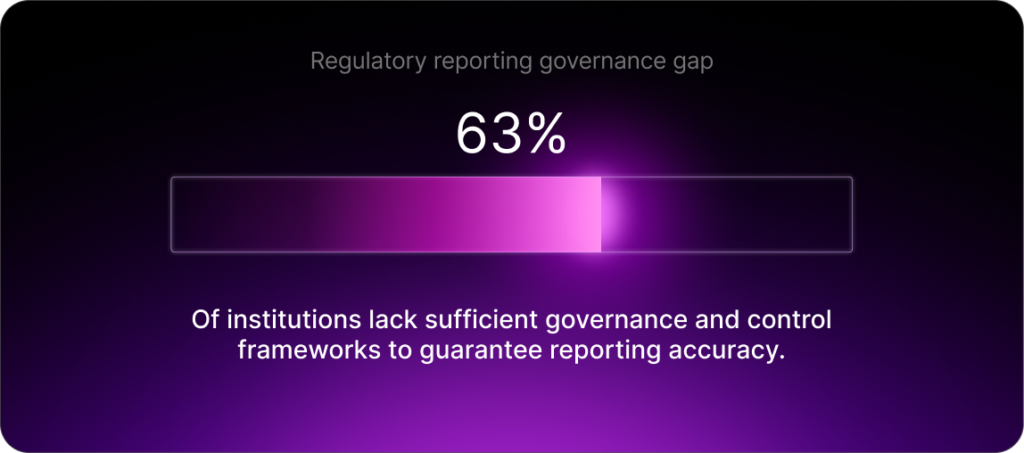
- 63% of institutions acknowledge they do not have a sufficient governance and control framework.
- The impact of AI goes far beyond mere operational efficiency.
Regulatory reporting has become one of the most complex and resource-intensive challenges facing the banking sector. In mobilizing numerous teams, multiple processes and exponentially growing data volumes, it illustrates the scale of the challenge that financial institutions face. The ongoing expansion of regulatory frameworks such as CRR3, DPM 4.x, Pillar 3 Data Hub, ESG reporting and DORA is driving an explosion in the volume and granularity of data being produced. As a result, the production of monthly risk reports can still take more than 40 working days, proof that processes remain burdensome and fragmented.
The challenge, however, is no longer simply producing reports. Today, the real issue is orchestrating the continuous processes needed to feed increasingly frequent and demanding reporting cycles. Problematically, as many as 63% of institutions acknowledge they do not have a sufficient governance and control framework to guarantee the accuracy and completeness of these reports.
In this context, legacy architectures struggle to keep up. Fragmented systems, inconsistent data definitions and reliance on manual processes undermine production and lead to:
- Reporting errors
- Reconciliation issues
- Operational inefficiencies
Behind these constraints lies an opportunity that remains largely untapped. Regulatory data constitutes a valuable base of information on risks and operations. With the right technologies in place, banks can transform regulatory reporting into a genuine source of strategic intelligence, rather than a mere compliance obligation.
How AI can address the main challenges of regulatory reporting
AI complements existing regulatory systems
Regulatory reporting has long relied on systems designed to guarantee traceability, auditability and the explainability of results. These rule-based systems remain indispensable, as they translate regulatory requirements into reliable calculations and rigorous controls.
AI does not, however, replace existing systems. Instead, it enriches them by integrating at several levels. Symbolic approaches make it possible to formalize deterministic rules and ensure a first level of validation guaranteeing compliance. Statistical AI models then complement the analysis by detecting anomalies or inconsistencies that deterministic controls don’t always identify.
Finally, generative and agentic AI capabilities add a new dimension by supporting users in understanding regulatory requirements and analyzing results.
Improving data quality and consistency
One of the main friction points in regulatory reporting is the late detection of errors. Machine learning models can now compare current data against historical records or expected patterns in order to identify anomalies or inconsistencies between different reports earlier in the process. Where teams previously intervened at the end of the chain, these controls can now be activated upstream.
These intelligent auto-reconciliation capabilities also allow for more efficient handling of data from multiple systems, while intelligent, assistants notably in the form of chatbots, facilitate the understanding of validation rules and the analysis of errors. This makes it possible to improve data quality and significantly reduce manual corrections.
Reducing operational costs
A significant portion of reporting work is still devoted to repetitive tasks: data validation and reconciliation, anomaly correction.
By automating these processes, AI reduces the operational burden while strengthening the accuracy of controls, allowing teams to focus on higher value-added activities.
Accelerating reporting cycles
Faster, automated validation and reconciliation processes reduce reporting production lead times.
Banks gain in efficiency and can absorb the continuous increase in regulatory requirements without proportionally increasing their resources.
Accelerating Time-to-Compliance in the face of regulatory changes
In an environment where regulations are constantly evolving, new templates, new rules, new requirements, the ability to adapt becomes critical.
AI can help teams identify gaps between two versions of a regulatory text, adapt data mappings more quickly and detect potential inconsistencies upstream.
As a result, banks can implement new regulatory requirements more rapidly, while limiting the risk of errors and operational disruptions.
From regulatory reporting to strategic intelligence
The impact of AI goes far beyond mere operational efficiency.
Regulatory data, long used for declarative purposes, can now be exploited proactively for risk monitoring, scenario analysis, regulatory impact simulation or anticipating prudential thresholds. It also enables more precise management of solvency and liquidity ratios.
Reporting no longer simply retraces the past. It is transforming into a genuine decision-support tool, serving a proactive regulatory intelligence function.
| Dimension | Traditional approach | AI-augmented approach |
| Report production | Manual, lengthy and fragmented processes | Automated validation, auto-reconciliation and production |
| Data quality | Late error detection | Proactive detection of anomalies and inconsistencies |
| Reporting cycles | High lead times, limited flexibility | Shortened processes and improved adaptability |
| Compliance | Slow adaptation to new regulations | Rapid gap identification and accelerated implementation |
| Data usage | Declarative, retrospective approach | Proactive analysis, simulation and strategic steering |
| Role of reporting | Compliance obligation | Strategic asset serving decision-making |
The challenges of AI adoption in regulatory reporting
Adopting AI in regulatory reporting is not merely a technological challenge. It involves rethinking sometimes outdated foundations, within an environment strongly constrained by governance and compliance requirements.
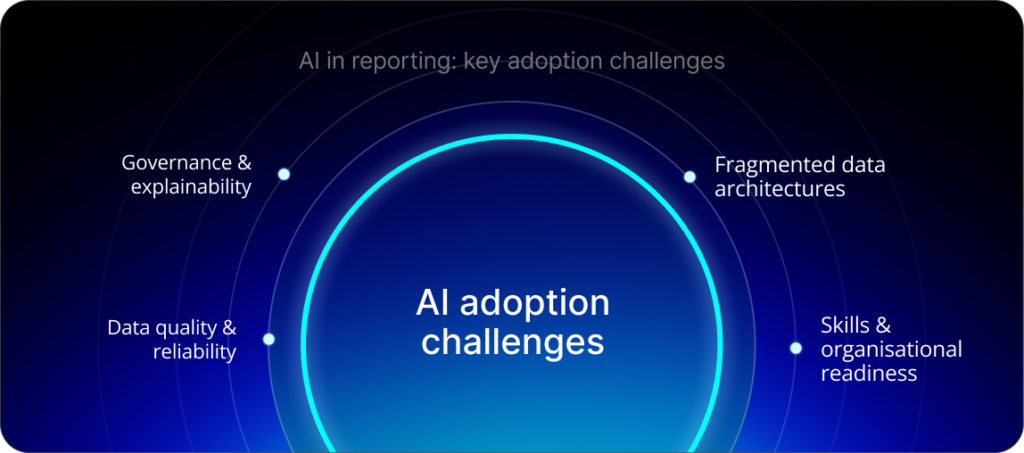
Several structural challenges must be addressed to fully benefit from it:
- Increased requirements in terms of governance and explainability. AI models cannot be used as opaque systems. Every result produced must be explainable, every data transformation traceable and the rigor of controls demonstrable. As regulatory supervision tightens, expectations around transparency, auditability and model monitoring over time are intensifying. Recent frameworks such as DORA are also heightening expectations regarding traceability, operational resilience and systems governance.
- Still-fragmented data architectures. In many banks, data remains spread across multiple legacy systems, often designed independently of one another. This fragmentation complicates consolidation and limits the ability to produce a coherent and reliable reporting view. Introducing AI capabilities into these environments can prove complex if the foundations are not sufficiently solid. Strong data integration is therefore necessary before AI can be fully leveraged.
- Data quality and reliability challenges. The effectiveness of AI depends directly on the quality of the data it relies upon. Incomplete, inconsistent or poorly governed data can compromise results and introduce new risks. It becomes essential to ensure clear data lineage, harmonized definitions and strengthened governance frameworks to prevent AI from amplifying existing problems.
- A need for skills adaptation and organizational readiness. Adopting AI implies an evolution of skills and ways of working. Institutions must be able to develop internal expertise in data science, regulatory technologies (RegTech) and model governance. At the same time, it is essential to adapt internal processes. The challenge is not only to deploy new tools, but to integrate them effectively into existing production chains.
These challenges do not call into question the potential of AI. Rather, they condition its success. Without solid foundations in terms of data, governance and organization, the expected benefits remain difficult to achieve.
How SBS can help
Faced with these challenges, integrating AI into regulatory reporting cannot be done in isolation. It rests on solid foundations in terms of data, governance and architecture. This is precisely the approach taken by SBS with SBS Regulatory Reporting, designed as a unified platform built to support these requirements.
By centralizing data from risk, finance and operations systems, this approach makes it possible to establish a single, coherent and reliable source. This unification reduces silos, facilitates reconciliation between sources and improves the quality of data used in reports.
On this basis, automation plays a key role. The platform covers the entire reporting cycle:
- Data collection from source systems to consolidate information in a coherent manner
- Automated data validation helps detect anomalies earlier in the reporting process
- Reconciliation between different sources and reports to guarantee overall consistency
- Production of regulatory reports in compliance with the required standards and formats
Automation reduces dependence on manual processing and improves both operational efficiency and process rigor in the face of growing reporting volumes.
By embedding governance at the heart of the architecture, SBS Regulatory Reporting strengthens confidence in the data and results produced. Integrated data validation, traceability, data lineage and complete auditability are all levers that will satisfy the growing requirements of regulatory supervisors.
Beyond compliance, SBS Regulatory Reporting transforms regulatory data into a strategic lever. Its real-time analytics and business intelligence capabilities offer better risk identification and facilitate decision-making. Regulatory data then becomes genuinely actionable insights, providing a proactive view across multiple issues.
How AI powers regulatory reporting at SBS?
The platform is designed to progressively integrate AI capabilities, such as anomaly detection, predictive data validation and intelligent auto-reconciliation, as well as intelligent assistants in the form of agents or chatbots that will support users in understanding regulatory requirements and analyzing data.
By combining a scalable, automated reporting architecture with a controlled integration of AI, SBS enables banks to modernize their regulatory reporting without compromising the requirements of control, transparency and compliance.
Questions and Answers
No. It complements them by bringing analysis capabilities, anomaly detection and user assistance, while retaining deterministic engines as the compliance foundation.