
- Wero represents the next phase of European payments infrastructure.
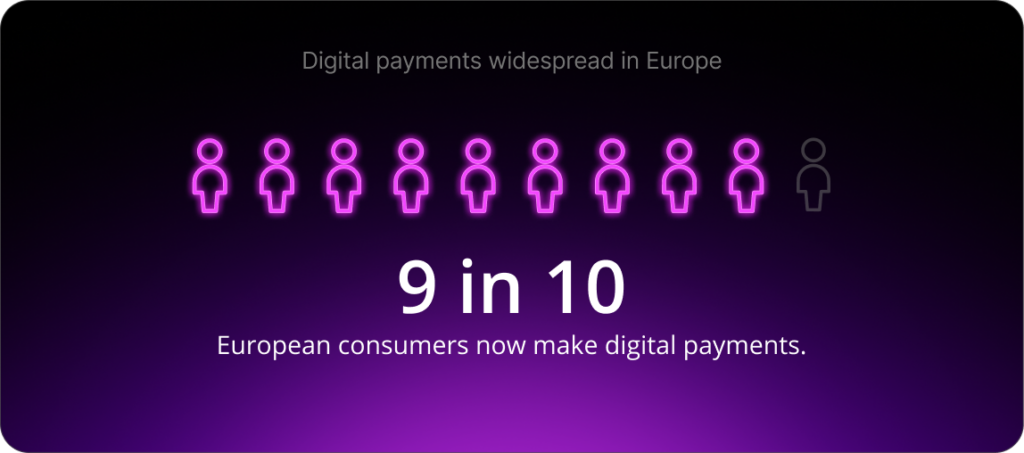
- Roughly 9 in 10 European consumers made some form of digital payment in the past year.
- 71% of European consumers cite easier and faster checkout as a primary reason for using digital wallets.
European retail payments are entering a decisive moment. After decades of nationally optimized rails, Europe is shifting toward interoperable, real-time infrastructure that must work across borders and at scale. Wero is the clearest signal of that shift. At the same time, digital wallets are redefining how customers initiate transactions, compressing the distance between interface, scheme and settlement. McKinsey’s 2024 Digital Payments Survey found that roughly nine in ten European consumers made some form of digital payment in the past year, and 71% cited easier and faster checkout as a primary reason for using digital wallets. In other words, experience expectations are hardening fast.
This is not just a technology upgrade. It shifts where payments infrastructure sits, how schemes coordinate participants and where value is captured across the ecosystem. Wero represents the next phase of European payments infrastructure. For banks, the strategic imperative is clear: to integrate Wero seamlessly across channels and core systems. The execution challenge is less clear: how to do it without recurring re-engineering, rising operational overhead and delivery volatility as the scheme evolves.
What is Wero, and how is its ecosystem structured?
Launched in 2024, Wero is a bank-backed digital wallet and pan-European payment scheme. It was created to unify account-based payments across peer-to-peer, e-commerce, and, over time, point-of-sale and omnichannel use cases. Wero’s ambition is not to add another payment method, but to provide a common scheme that can replace today’s fragmented domestic landscape with interoperable rules, services and reach across borders. We explore this in more detail in our October 2025 study, Why Wero is Europe’s best bet to compete in the global payment race.
The scheme is operated by European Payments Initiative (EPI), which owns the scheme rulebook and specifications, runs the central service layer, and drives the roadmap as new capabilities and use cases are introduced.
Issuing banks sit at the center of Wero enablement. They offer Wero either within their existing digital applications or via a standalone wallet, depending on market strategy. Participation requires more than connecting to a central API. Banks must support end-to-end flows in both directions, integrating EPI’s central services with their own payment engines, security and fraud controls, operational processes, and digital channels.
On the acceptance side, PSPs and acquirers connect merchants to the Wero ecosystem, enabling Wero across e-commerce platforms, point-of-sale environments and omnichannel journeys. Together, these roles position Wero as a full scheme and infrastructure layer rather than a simple front-end wallet.
| Actor | Role in the Wero ecosystem |
| European Payments Initiative | Operates the scheme and central services. Defines specifications, security standards and the roadmap as Wero evolves across markets and use cases. |
| Banks (Issuers) | Offer Wero within their digital channels or via a standalone wallet. Enable two-way interoperability with EPI central services, exposing services and data for inbound and outbound flows across their own systems. |
| PSPs / Acquirers (Acceptors) | Enable merchant acceptance by integrating retailers into the Wero ecosystem across e-commerce, point-of-sale and omnichannel environments. |
| SBS | Acts on behalf of issuing banks as the orchestration layer between EPI central services and a bank’s core systems, payment engines and digital channels. |
Momentum is building… but so are expectations
What began as a controlled peer-to-peer (P2P) rollout is now expanding into broader commercial and retail environments, with momentum accelerating across both the issuance and acceptance sides of the ecosystem.
P2P payments are already live in Belgium, France and Germany, establishing Wero as an operational consumer payment scheme across multiple major markets. At the same time, acceptance is scaling beyond initial launch phases into structured merchant enablement. E-commerce is live in Germany and Belgium, with France next in line, followed by Luxembourg and Netherlands through 2026. Point-of-sale and omnichannel capabilities are expected to roll out in the next couple of years, as central services mature and merchant infrastructure expands.
This expansion is being reinforced by growing investment on the acceptance side. Major PSPs and acquirers are accelerating merchant onboarding, strengthening coverage across key European markets and improving the near-term business case for issuing banks. The entry of Mollie as an EPI Principal Member in early 2026, for example, significantly broadened Wero’s merchant reach across a large pan-European base, signalling that acceptance momentum is now moving at scale.
Several market-specific developments underline how quickly Wero is shifting from optional experiment to strategic necessity.
- In the Netherlands, the domestic payment scheme iDEAL is progressively transitioning toward Wero, illustrating how national payment systems may converge into a common European infrastructure over time. The migration is expected to culminate in a full iDEAL phase-out by mid-2027, with initial Wero payments anticipated from March 2026.
- In France, early phases have focused largely on branding and continuity of user experience. However, the real delivery pressure will rise as Wero expands into e-commerce, point-of-sale and richer payment capabilities that require deeper system integration and operational readiness.
- In Luxembourg, consumer availability is planned via local banks in 2026, alongside a coordinated migration from Payconiq toward Wero on the acceptance side.
- In Austria, preparations for Wero participation are underway. Local infrastructure providers are enabling issuing support for banks, laying the groundwork for integration with the scheme. While a consumer rollout timeline has not yet been confirmed, this signals Wero’s gradual expansion into Central Europe.
What enabling Wero requires: Operational and technical considerations
Despite its consumer-friendly wallet interface, Wero is not a conventional payments integration project. For issuing banks, enabling Wero means establishing a new scheme layer that must operate in real time, remain continuously compliant and evolve alongside the scheme roadmap.
Rather than delivering a one-off connection, banks are building a living infrastructure that expands progressively as Wero moves from P2P into e-commerce, point-of-sale and richer payment capabilities. The scheme framework itself already anticipates multiple payment plans/consent types (for example pre-authorized payments, deposits, subscriptions, installments, one-click and refunds), which structurally pushes banks toward extensible designs rather than hard-coded “single flow” implementations.
That extensibility requirement runs deeper than architecture alone. With Wero, the defining challenge is not connectivity; it is orchestrating provisioning, authentication, directory services, execution and settlement in real time, across a scheme that will keep evolving.
To support this evolution, institutions must design for change and scale from the outset. This includes:
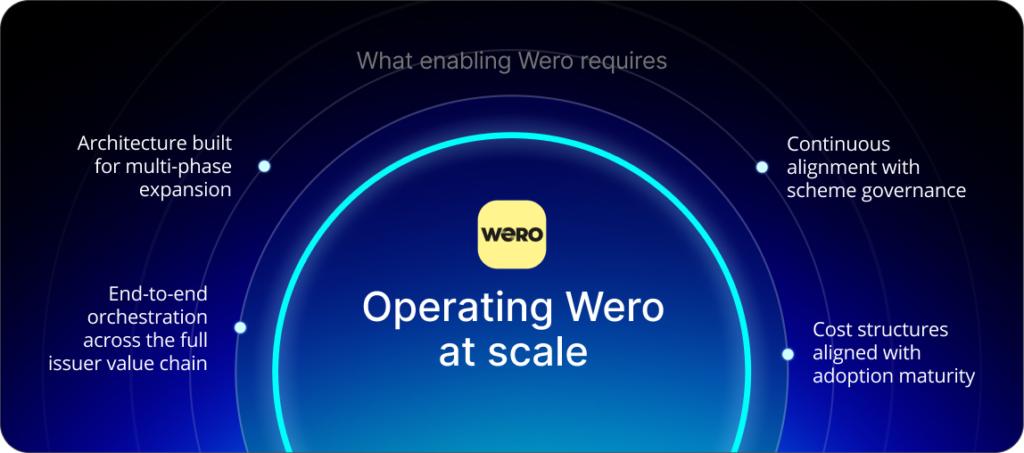
- Architecture built for multi-phase expansion. Supporting advanced payment plans such as subscriptions, deposits, instalments and refunds, alongside capabilities like buyer protection, cross-border interoperability and future wallet, identity and loyalty services.
- True end-to-end orchestration across the full issuer value chain. This is not “one small API and happy flows,” but coordinated real-time workflows spanning provisioning and customer consent, proxy and directory services (for example phone number/email/QR-based addressing), strong customer authentication, payment execution, notifications, reconciliation processes and dispute handling.
- Continuous alignment with scheme governance. Externally governed approval cycles, certification processes and review feedback shape both technical and functional requirements with tight release timelines. For example, EPI-accredited security evaluators are explicitly positioned to perform security evaluations for certification/approval, including on the EPI service platform and connected service providers.
- Cost structures aligned with adoption maturity. Early volumes are uncertain, while full-stack builds typically front-load development, compliance and operational investment ahead of usage scale.
Execution risks: Where complexity emerges
While these requirements are conceptually clear, many banks are discovering how difficult they are to deliver sustainably through traditional build models. Technical complexity typically surfaces first in orchestration itself. What appears to be a simple payment flow quickly becomes a web of asynchronous, real-time interactions across provisioning, authentication, payment execution, notifications, reconciliation and dispute events. Managing these non-linear flows under strict performance and compliance constraints introduces significant technical and operational overhead.
As the scheme evolves, a second layer of complexity compounds. Each new phase introduces additional transaction types, exception scenarios, security requirements and operational controls. Without architecture designed for extensibility, banks are forced into repeated re-engineering cycles, frequent release adjustments and growing delivery volatility.
Beyond technical and scheme-related challenges, commercial pressure also emerges from uneven market readiness. Where merchant acceptance lags issuer enablement, banks incur ongoing run costs while transaction volumes and business value remain limited, stretching ROI timelines. Certification and approval cycles add further friction. Late feedback, evolving interpretations of scheme rules and last-minute changes regularly trigger rework that disrupts roadmaps and strains delivery capacity.
Crucially, the impact of Wero enablement extends far beyond digital channels. It reaches into core banking and payment engines, security infrastructure such as HSMs and key management systems, fraud and risk platforms, reconciliation and dispute operations, and compliance and audit workflows. When these downstream dependencies are surfaced late, remediation becomes both expensive and schedule-critical. Taken together, Wero programs are rarely constrained by a single technical hurdle. They are constrained by the cumulative effect of technical orchestration complexity, ongoing scheme evolution and uneven market readiness, combined with their end-to-end operational impact.
De-risking Wero enablement: The case for a strategic integration partner
The demands of Wero go well beyond what traditional middleware or standalone integrations are designed to handle. For banks, the strategic question is not how quickly they can connect, but whether they can build and operate an orchestration layer that stays aligned as the scheme evolves. In practice, this is a choice between running a fast-evolving scheme capability in-house, or adopting an industrialized issuer side layer designed to absorb continuous change and end-to-end operational complexity. As a result, banks are increasingly turning to industrialized orchestration approaches that absorb scheme evolution without repeated re-engineering.
SBS offers a Wero orchestration layer built explicitly for this reality.
- EPI-aligned architecture that evolves continuously with the scheme, absorbing specification changes centrally and reducing repeated re-engineering for banks.
- Pre-integrated end-to-end flows across wallet provisioning and consent, proxy resolution, payments across P2P, P2PRO and e- and m-commerce use cases, strong customer authentication, exception handling and compliance.
- Support for complex use cases as modular building blocks, including recurring payments, installments, refunds and buyer protection, which can be activated progressively without re-platforming.
- Accelerated delivery and reduced certification friction through validated integration patterns and reusable testing assets that shorten review cycles and limit late-stage rework.
- Flexible deployment models across SaaS and on-premise environments, aligned to regulatory, sovereignty and integration strategies underpinned by enterprise-grade certifications including ISO 27001, SOC 2 and SOC 3, and continuous compliance monitoring to keep banks aligned with DORA and GDPR.
- Cost structures aligned to adoption maturity, enabling banks to begin with subscription models aligned to early volumes and scale investment as usage grows, rather than front-loading major build costs.
SBS also supports market-aligned rollout strategies, helping banks time issuer launches with merchant acceptance readiness so deployments generate real usage rather than purely technical enablement.
Because our solution spans issuer-side orchestration, instant payments capabilities and integration patterns across cores and payment processing, banks can consolidate adjacent components around Wero, as we simplify integrations, reduce operational overhead and lower total cost of ownership.
For banks, the real cost of Wero is not simply in standing up the service. It is staying continuously aligned as the scheme evolves, managing downstream operational impacts and scaling without fragmentation. With the right partner in place, Wero enablement shifts from a recurring integration burden to a strategic platform capability, unlocking pan-European reach, faster innovation and long-term infrastructure resilience.
Contact a member of our team today to discuss a Wero enablement approach that matches your roadmap, operating model and rollout markets.
Questions and Answers
In practice, no. Wero requires non-linear, real-time orchestration across wallet provisioning and consent, proxy and directory services, authentication, payment execution, reconciliation processes and dispute handling, all operating under evolving scheme rules.