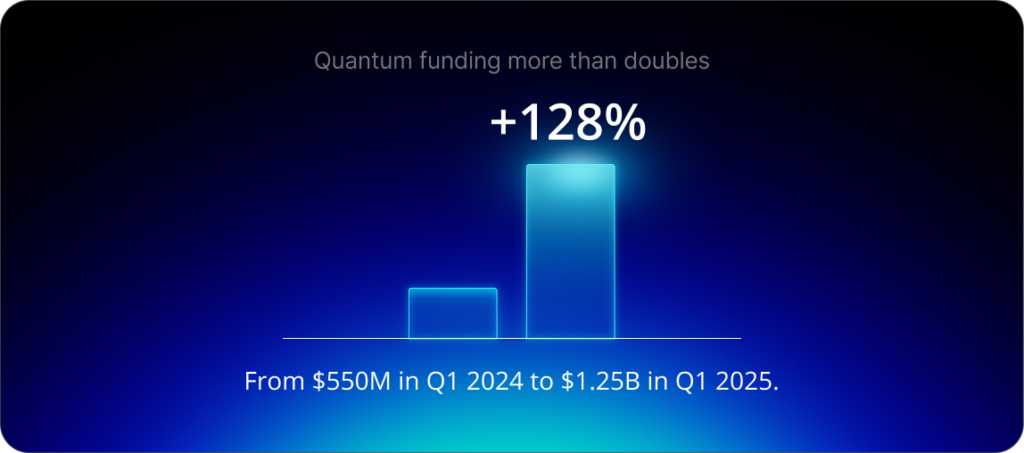
Quantum computing is fast emerging as a technology that has the potential to revolutionize an increasingly complex, data-driven finance sector. From portfolio optimization and risk modelling to enhanced cybersecurity and faster decision-making, financial institutions are exploring the technology to tackle computational challenges that are stretching the limits of traditional computer systems. Interest in the technology is accelerating. Global investment in quantum computing surged to more than US$1.25 billion in the first quarter of 2025, data from The Quantum Insider’s Intelligence Platform shows. The market is forecast to grow rapidly over the next decade, signalling a shift from research to commercial readiness, it adds.
Meanwhile, a report by McKinsey & Company says quantum computing will have “profound implications” in three key areas of the finance industry: optimizing complex financial processes, enhancing the power of machine learning, and strengthening secure communications. In financial services, this “emerging technology” computes more efficiently when generating probability distributions, mapping data, testing samples, and iterating, according to a report by IBM.
“Applying emerging quantum technology to financial problems – particularly those dealing with uncertainty and constrained optimization – should prove hugely advantageous for first movers,” IBM states.
“Imagine being able to make calculations that reveal dynamic arbitrage possibilities that competitors are unable to see. Beyond that, greater compliance, employing behavioral data to enhance customer engagement, and faster reaction to market volatility are some of the specific benefits we expect quantum computing to deliver,” it adds.
What is Quantum Computing?
In contrast to traditional computer systems, which use binary that represent either a zero or a one, quantum computers use quantum bits, or qubits. This means that quantum computers can explore a much larger range of potential outcomes at once, making them useful for complex, high-dimensional problems.
Quantum computing is more efficient at generating probability distributions, mapping large datasets, testing multiple scenarios, and iterating through vast combinations – tasks that are increasingly common in financial modelling and optimisation.
According to the IBM report, the solution space of a quantum computer is “orders of magnitude larger” than traditional computers. This gives quantum computers an enormous advantage, the company says, as the technology’s power doubles when one qubit is added.
Quantum Computing in Finance Today
Major financial institutions and technology providers are already experimenting with quantum computing by combining it with traditional systems in an effort to improve performance for specific tasks. These include portfolio optimization, an area in which possible outcomes have the potential to overwhelm traditional computing. In these cases, quantum techniques are being used to evaluate multiple scenarios simultaneously, offering potential gains in speed and accuracy.
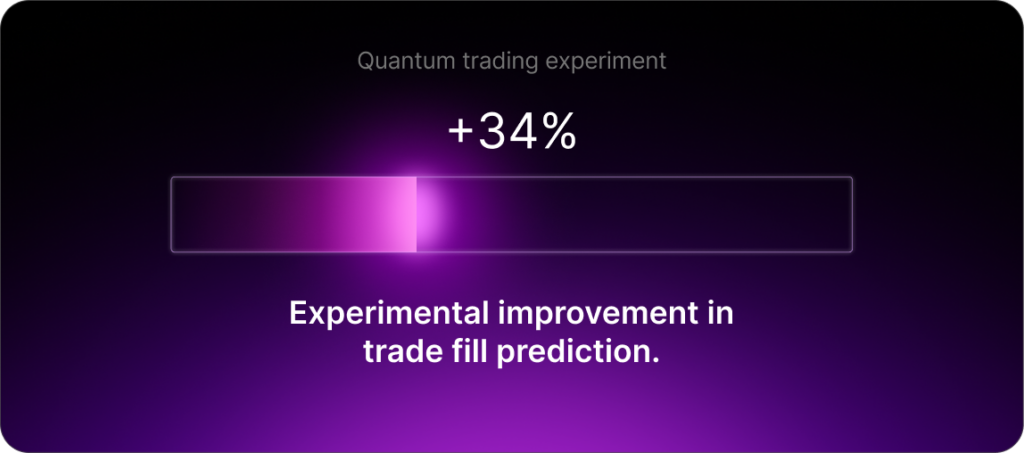
In September 2025, global banking giant HSBC, in partnership with IBM, demonstrated the world’s first known example of quantum-enabled algorithmic trading. According to HSBC, the experiment delivered up to a 34% improvement in predicting the likelihood that a trade would be filled at a quoted price compared with industry-standard classical computing techniques.
“This is a ground-breaking world-first in bond trading,” Philip Intallura, HSBC Group’s head of quantum technologies, said at the time. “It means we now have a tangible example of how today’s quantum computers could solve a real-world business problem at scale and offer a competitive edge, which will only continue to grow as quantum computers advance.”
While projects such as the HSBC and IBM one remain experimental, they offer an insight into how quantum computing can bring practical value to the finance sector, eventually enhancing existing systems and analytical tools.
Use Cases for Quantum Computing
A report by SpinQ Technology shows there are several use cases that are attracting attention in the finance world, primarily because they involve complex calculations that are difficult to solve efficiently on classical systems.
- Portfolio optimization: Perhaps the most cited example is portfolio optimization, which typically requires evaluating vast numbers of asset combinations. Quantum computing can explore these more efficiently, potentially boosting diversification and risk-adjusted returns for investors.
- Risk modelling and scenario analysis: Financial institutions routinely assess thousands of scenarios to understand their risk exposure. Quantum computing’s ability to evaluate many outcomes could enhance stress testing in finance and improve the speed and depth of risk analysis.
- Trading and market simulation: Quantum techniques are already being trialled to improve trade executions, liquidity modelling, and price discovery by analyzing complex market dynamics and probable outcomes more effectively than traditional models.
- Fraud detection and security: While still in its early stages, quantum computing could eventually support faster detection of anomalies and suspicious activity across financial systems.
According to a report by the World Economic Forum (WEF), the above use case examples fall into three key areas:
- Quantum computing: More accurate risk modelling, fraud detection, and portfolio optimization.
- Quantum security and communications: The WEF describes this as theoretically unbreakable encryption through methods such as quantum key distribution (QKD) and quantum random number generation (QRNG).
- Quantum sensing: Precise measurement capabilities that may be used to heighten the synchronization of high-frequency trading (HFT) algorithms.
“While still nascent, the first two areas provide the most opportunity for the financial services industry, although more will need to happen to scale them,” the WEF notes.
“To derive meaningful value from quantum technologies, financial institutions will need to go beyond experimentation and pilot phases,” it adds.
Security implications and cryptography
There is a dual-edged security impact for financial services in quantum computing: it threatens the foundations of today’s cryptographic systems while also enabling quantum-safe security solutions. Today’s financial encryption methods rely on mathematical problems that classical computers cannot efficiently solve. However, powerful quantum computers could one day break these protections, exposing sensitive data and critical infrastructure.
However, quantum technologies like post-quantum cryptography (PQC), QKD, and QRNG offer new ways to secure financial communications and transactions against both current and future threats.
According to a McKinsey & Company report, PQC and QKD are the leading approaches to make data quantum-safe.
“PQC algorithms are classical, quantum-resistant algorithms consisting of cryptographic problems that are computationally difficult,” the company notes. “QKD uses quantum properties to establish a secure communication channel between two parties. Any attempt to eavesdrop or intercept the exchange of encryption keys would be detected, causing the secret keys to be discarded,” it adds.
Adoption challenges
At this stage, however, adoption of the technology is limited by technical and practical challenges. Access to the hardware is also limited and specialist skills are difficult to source, primarily because the technology continues to evolve. While trials have been promising, six foundational pillars must be prioritized before the full potential of quantum computing in finance can be realized, according to a WEF white paper.
These include: research and development; infrastructure enablement; public-private collaboration; entrepreneurship support; education and workforce development; and responsible deployment of the technology.
While commercial use is still several years away, the potential of quantum computing is beginning to shape strategic planning across the finance sector. As financial institutions contend with increasing complexity in markets, risk and security, quantum technologies offer a possible solution to problems that are pushing the limits of classical computer systems. In the meantime, the focus remains on trialling the technology to ensure that it reaches its full potential and can be used securely.
For more expert content on industry outlooks and innovation, subscribe to our newsletter or visit our Insights page.
Is quantum computing being used in mainstream finance today? + –
No, the technology is still being trialled through pilot projects and research initiatives, such as the partnership between HSBC and IBM.
What challenges does quantum computing help solve in finance? + –
According to studies, it shows potential in areas that require complex computing processes, such as optimizing investment portfolios, risk modelling, and enhanced cybersecurity.
Will quantum computing replace classical computing systems in finance? + –
Currently, the pilot projects are combining quantum technologies with classical computers to test how performance can be improved for specific tasks.
How big is the quantum computing market? + –
As of the first quarter of 2025, the sector was valued at more than US$1.25 billion. It is forecast to grow rapidly over the next decade as it approaches commercial readiness.
How should the finance sector prepare for quantum computing? + –
According to the WEF, the sector should begin preparing for this technology now, including research and development, exploring infrastructure enablement, and developing education and workforce programs.