
- QR enables banks and businesses to trigger instant invoice settlements, A2A payments, and request-to-pay flows with one scan.
- It delivers lower transaction costs and leverages growing interoperability between domestic and cross-border instant payment rails to streamline operations.
- Regulators in the EU, US and UK are pushing instant, data-rich transfers that support VoP, fee parity and reachability.
- MEA central banks and national switches are driving interoperable QR schemes, accelerating merchant acceptance and A2A adoption.
In Germany, a supplier logs into their account with Deutsche Bank and scans a QR code to settle an invoice through SEPA Instant Credit Transfer (SCT Inst), the European Union’s real-time account-to-account (A2A) transfer scheme within the Single Euro Payments Area (SEPA). Thanks to a dynamic QR code that has been embedded into invoices, the need for manual IBAN entry or costly SWIFT transfers has been eliminated. Instead, the supplier simply scans the QR code in the invoice, confirms the transaction, and transfers the payment immediately.
In B2B, two QR models are used:
- A fixed code the payer scans and enters the amount
- A dynamic code that pre-fills the amount and invoice details for straight-through processing
First developed in 1994, QR, or Quick Response, codes have long been associated with contactless retail payments and person-to-person transfers. However, QR has rapidly evolved into a viable, dynamic B2B payment option. The technology offers a streamlined, cost-effective option for instant, A2A payments for businesses navigating high volumes of receivables and payables. Several factors are driving the adoption of QR in B2B payments, including lower transaction costs, a growing interoperability between domestic and cross-border instant payment rails, and new regulations.
For the banking and financial services sector, the shift to QR presents both challenges and opportunities. By offering programmable, QR-enabled payment capabilities, the sector can help reshape how businesses settle invoices and manage cash flow in real time.
This evolution positions QR as the front door to instant programmable finance, giving banks a competitive edge in corporate payments.
Market momentum
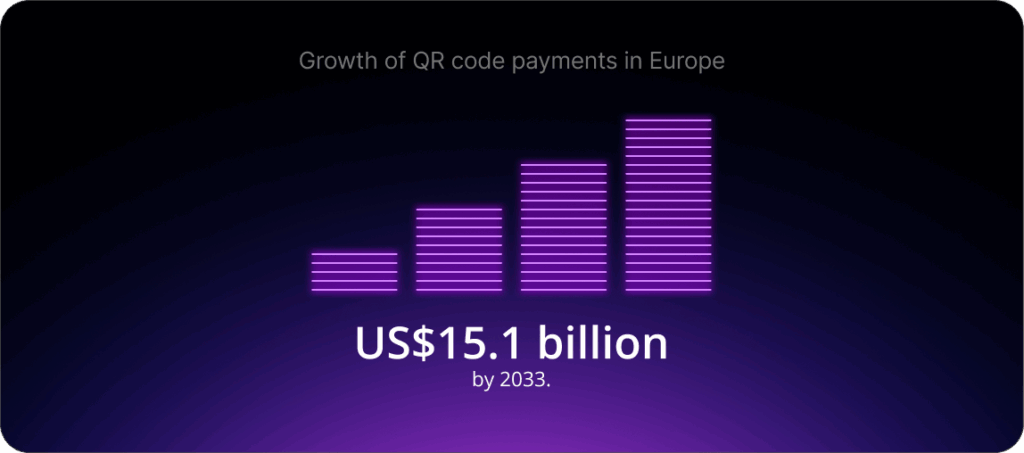
QR code payments have become a strategic lever for banks as the technology moves beyond consumer convenience. As payment rails are modernised and regulations are strengthened, QR is becoming the intuitive front end to real time A2A for corporate finance, with banks increasingly embedding QR into corporate portals, invoicing systems, and merchant solutions. In Europe, the QR code payments market was valued at US$3.1 billion in 2024 and is expected to grow at a compound annual growth rate (CAGR) of 19.9% through to 2033 to reach US$15.1 billion, according to Grand View Research.
Cost is also a near-term driver. According to a report by the UK Payment Systems Regulator, Visa and Mastercard have increased their core scheme and processing fees by at least 25% since 2017, costing businesses more than £170 million per year. This rising financial pressure makes lower-cost A2A/QR particularly attractive for SMEs and their banks.
In Germany, businesses can opt for the Sparkasse app, which scans GiroCodes on invoices to auto-populate SEPA transfers for small and medium-sized enterprises, while Deutsche Bank’s SmartÜberweisung and DB QRPay also enable QR acceptance for merchants.
Banks in the Netherlands, including ING, Rabobank, and ABN AMRO, support bank-app journeys and desktop-to-mobile via QR through platforms such as iDEAL. Spain’s Bizum platform, offered through the likes of BBVA, CaixaBank and Santander, is QR-enabled for in-person and commerce use. Accepted by tens of thousands of e-commerce merchants, Bizum underscores that banks are enabling merchants to generate and accept QR/A2A at scale.
Across the Middle East and Africa region (MEA), the momentum is regulator-led: national switches are rolling out interoperable QR and onboarding banks on top of mature A2A rails. For example, South Africa’s PayShap has processed more than 100 billion rand across an estimated 136 million transactions since launch.
Meanwhile, Nigeria’s instant payment rails (NIP) moved 1.07 quadrillion Naira in 2024, with the national NQR scheme providing a QR front end for merchant acceptance. Programs typically launch with static QR, then expand to dynamic QR for B2B invoicing, helping banks meet mandates and capture lower-cost merchant flows.
Adoption is also growing in the UK, where revenue reached US$788.1 million in 2024, with Grand View Research projecting that the sector will grow at a CAGR of 19.9% to hit US$3.84 billion by 2033. UK bank NatWest’s Payit platform collects online or in-person payments via a scannable QR that can be used for invoices or at points of sale. Meanwhile, Lloyds Bank has introduced Link Pay, which generates QR codes or payment links to request funds securely.
Standards work is also underway in the US, which allows one QR format to trigger payments across the FedNow, RTP and ACH networks, with recent pilots showing sub-second settlements – useful as a reference point for how QR standards are converging.
Regulatory push
Several markets in the MEA are following a regulator-led path. Central banks and national switches are onboarding banks to interoperable QR on top of real-time rails, making connection and interoperability a near-term compliance priority and a practical way to lower acceptance costs for merchants.
Across Europe, the US and UK, regulators are moving to unlock A2A payment rails that support instant, data-rich transfers. In the EU, the Instant Payments Regulation mandates reachability for instant credit transfers, fee parity, and Verification of Payee (VoP).
The EU’s proposed third Payment Services Directive (PSD3) and Payment Services Regulation (PSR) frameworks aim to strengthen fraud controls, transparency and supervision that will complement instant payments by making A2A stronger.
The regulatory changes also signal an operational urgency for banks to be prepared to embed QR into client-facing channels within the next 12 to 18 months. However, banks that implement QR early can capture new flows; those that delay risk losing them to fintechs and alternative payment providers.
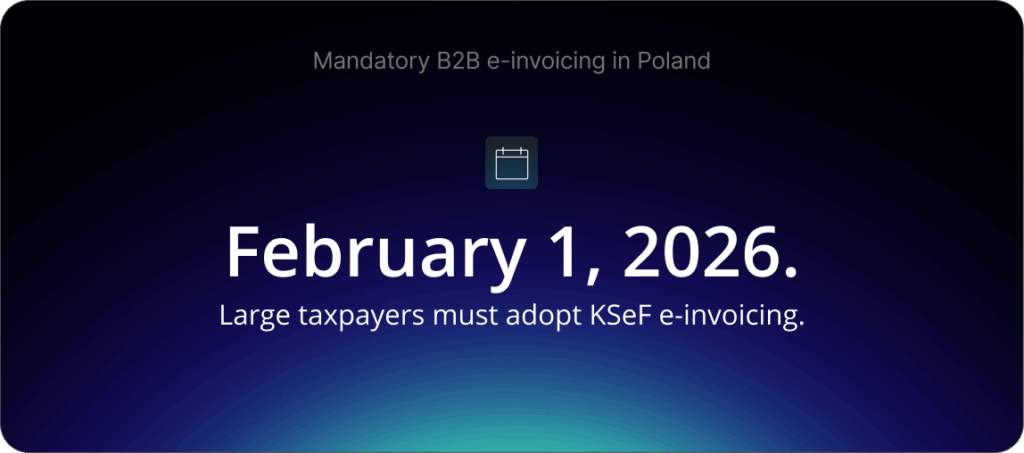
Some EU countries are going a step further. Poland, for example, will begin introducing mandatory B2B electronic invoicing through its updated Krajowy System e-Faktur (KSeF) platform from February 1, 2026, for large taxpayers. From April 1, 2026, it will be expanded to all taxpayers. Originally published as a draft law in 2021, the revised regulation now covers QR codes on invoices and certificate changes.
While business-to-government e-invoicing has been mandatory in Germany since 2020, the country began a phased introduction of B2B e-invoicing for its XRechnung (B2G) and ZUGFeRD (B2B) platforms from January 1, 2025, which will be fully implemented by 2028. Both Poland’s KSeF and Germany’s B2B e-invoicing rollout are good examples of regulatory changes that will directly impact bank clients and, therefore, require urgent bank readiness.
In many MEA markets, central banks are directing bank connection to national QR schemes, making interoperability a near-term compliance requirement and a priority for product roadmaps over the next 12 to 18 months.
In the US, the FedNow and RTP platforms, together with the adoption of the X9 QR standard, are creating a foundation for standardised A2A QR acceptance across a range of businesses.
Why B2B QR is different
Business-to-business QR is a dynamic, programmable, and bank-led instant payment system, not just a digital payment convenience. QR codes in the retail sector feature a static code that customers scan via their smartphones to make payments. In contrast, QR codes for B2B payments are embedded with rich, structured payment data, such as invoice IDs, tax information, purchase order numbers, and remittance details.
This enables straight-through processing and eliminates the need for manual reconciliation. It also strengthens security by reducing the risk of fraud linked to manual IBAN sharing and allows automated anti-money laundering (AML) and know-your-customer (KYC) checks at the payment trigger by using the embedded data. For businesses handling high volumes of transactions, the benefits include faster cash flow, fewer errors, and seamless integration with ERP and AP systems.
As a result, QR has transformed into a mainstream banking practice rather than a mix of corporate and utility use cases, supporting value-added services like instant financing, embedded insurance, or analytics triggered by a payment event. Practical applications for QR are also emerging across various markets, including in Germany, where mid-sized manufacturers are integrating dynamic QR codes into e-invoices. This enables customers to settle bills instantly through SCT Inst and cuts payment cycles from days to seconds.
With Sparkasse, Deutsche Bank, NatWest and Lloyds already exposing these flows, QR has moved beyond pilots into routine, bank-run client experiences.
In the US, utility companies are using QR on bills to trigger instant payments through RTP and FedNow with real-time confirmation, while B2B marketplaces in France are also exploring QR for embedded payments at order confirmation.
How SBS can help
SBS can rapidly deploy bank-grade QR capabilities without re-architecting core systems, helping banks capture and retain high-volume B2B flows. Our API modules allow the integration of dynamic QR generation in e-invoicing, existing ERP and Treasury systems, as well as embedding QR-enabled A2A payments into portals, apps, PDFs, and email communications.
Banks can also provide merchant-branded tools and portals to generate and accept static or dynamic QR, view instant and confirmed settlements, and reconcile with ERP and AP using structured remittance data.
Our SBS Digital Banking Suite helps expose QR journeys across web and mobile, and SBS Instant Payments provides the real-time backbone.
The software supports any payment type, such as SCT Inst, FedNow, RTP, and local instant rails. It can also map custom payment types, with connectors to national switches and centralized QR schemes where required. Security and compliance tools are built in – tokenization, VoP, encryption, auditability – and the data-rich QR payload enables automated AML and KYC checks at the payment trigger.
As instant payment infrastructures mature across the EU, UK, and MEA – with the US as a useful benchmark – dynamic QR offers a cost-effective, secure entry point for businesses to receive and settle payments quickly and boost cash flow.
Adopting QR capabilities unlocks efficiency, lowers costs, and aligns with the next wave of regulation and user expectations. For the banking and financial services sector, it is the front door to instant, programmable finance, and an opportunity to capture new B2B payment flows efficiently and at scale.