

#Core Banking
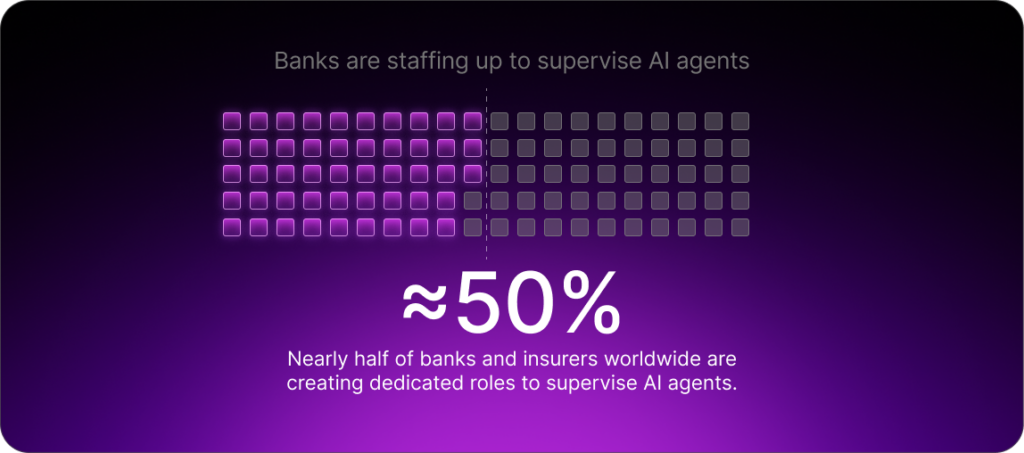
- Nearly half of banks and insurers worldwide are creating dedicated roles to supervise AI agents.
- In 2026, Santander and Mastercard completed Europe’s first live payment executed end-to-end by an AI agent.
- Open banking is evolving beyond its original role as a regulatory connectivity layer into a broader trust and orchestration layer.
Increasingly, AI systems are moving beyond simply helping customers make financial decisions to executing tasks on their behalf. AI agents are already being used to compare products, manage subscriptions, monitor spending and support financial decision-making. Over time, these capabilities are expected to expand further, with agents potentially initiating payments, managing routine financial tasks and orchestrating increasingly complex customer journeys. The pace of adoption is accelerating. According to Capgemini’s World Retail Banking Report 2026, nearly half of banks and insurers worldwide are creating dedicated roles to supervise AI agents. And in 2026, Santander and Mastercard completed Europe’s first live payment executed end-to-end by an AI agent. For banks, this shift is forcing a reassessment of open banking. Long viewed primarily through a regulatory lens, open banking is becoming increasingly strategic as AI agents take a more active role in financial decision-making and execution.
This creates new questions around consent, and banks will need to determine how authorization, consent and authentication frameworks can evolve from compliance mechanisms into strategic enablers of trusted automated finance.
The trust challenge at the heart of agentic finance
In order for AI agents to perform financial tasks effectively, they require secure, permissioned and auditable access to financial systems.
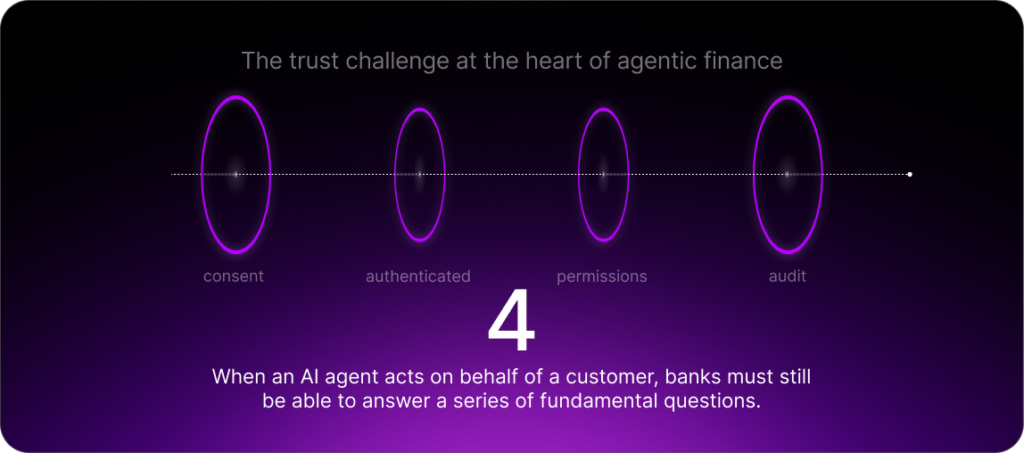
At first glance, this may appear to be a technical challenge. In reality, it is a trust challenge. When an AI agent acts on behalf of a customer, banks must still be able to answer a series of fundamental questions. Did the customer consent to the action? Was the action properly authenticated? Did the AI operate within the permissions granted to it? Can the institution explain and audit what happened if a transaction is disputed?
These requirements are not optional. They sit at the heart of banking’s role as a trusted intermediary.
The challenge is that AI agents introduce a new layer between customers and financial institutions. Rather than interacting directly with a bank’s channels, customers may increasingly rely on third-party agents to search for products, manage finances, initiate payments and execute financial decisions. And while these interactions may improve convenience and efficiency, they also create new governance requirements.
Failure to address these questions risks more than operational or compliance issues. It may also reduce banks’ visibility into customer interactions and weaken their role within increasingly AI-driven financial journeys.
This is where open banking infrastructure becomes increasingly relevant.
Many of the capabilities required to govern AI-driven financial interactions already exist within open banking frameworks. Consent management, authentication, secure API access, payment initiation and traceability all provide mechanisms for establishing trust across digital ecosystems.
However, these capabilities were designed for a world of direct human authorization. As financial activity becomes increasingly automated and delegated to AI agents, capabilities will face new operational demands. Permissions may need to persist over time. Financial actions may occur at machine speed. Authentication models may need to support delegated activity without creating excessive friction. Fraud controls may need to distinguish between legitimate autonomous activity and suspicious behavior. As a result, open banking is evolving beyond its original role as a regulatory connectivity layer. It is becoming a broader trust and orchestration layer for digital finance.
Is compliance-led open banking infrastructure enough?
The challenge is not that banks lack open banking infrastructure. Over the past decade, institutions have invested heavily in building the foundations required to participate in open banking ecosystems. The issue is that many of these investments were made to satisfy the requirements of a very specific environment: the world PSD2 created.
Today, the environment is changing. PSD3 and the Payment Services Regulation (PSR) are already raising expectations around authentication, fraud prevention, consumer protection and open banking performance. At the same time, agentic AI is introducing new questions around delegated authority, persistent permissions and increasingly autonomous financial activity.
These developments are changing the role open banking infrastructure plays within the financial ecosystem. Capabilities once viewed as compliance requirements are becoming strategically important control points.
For many banks, this shift exposes operational weaknesses. Open banking capabilities often remain fragmented across systems and operational silos. This fragmentation creates growing operational risk in environments where banks may need to govern persistent delegated authority, machine-speed activity and continuous AI-driven interactions.
Institutions must also balance stronger governance and authentication requirements with the need to avoid introducing excessive friction into customer experiences. The challenge is not simply securing automated finance, but doing so in a way that preserves usability, trust and customer engagement.
| Yesterday’s challenge | Tomorrow’s challenge |
| Enabling secure access to financial services | Governing trusted automated financial activity |
| Managing direct customer consent | Managing delegated authority and permissions |
| Authenticating customer actions | Authenticating AI-driven interactions |
| Monitoring customer behavior | Monitoring customer and machine-driven behavior |
| Meeting PSD2 requirements | Meeting PSD3/PSR expectations and AI-era governance demands |
| Building open banking capabilities | Operationalizing them at scale |
| Compliance-led infrastructure | Trusted control infrastructure |
Building open banking infrastructure for automated finance
As financial activity becomes increasingly automated, banks will need to determine whether their open banking infrastructure can govern trusted delegated action at scale while maintaining appropriate levels of security, control and auditability.
For many institutions, this means moving beyond compliance-led API exposure toward more deeply integrated governance, authentication and orchestration capabilities.
Rather than viewing open banking as a channel or connectivity layer, banks may increasingly need to view it as strategic infrastructure capable of governing how financial activity is authorized, executed and monitored across complex digital ecosystems.
This requires institutions to assess whether their existing capabilities can support:
- Persistent and revocable delegated permissions
- Stronger consent lifecycle management
- SCA models adapted to increasingly automated workflows
- Real-time fraud monitoring capable of identifying abnormal machine-driven behavior
- Secure payment initiation and authorization controls
- Stronger API governance across third-party and AI-driven ecosystems
- End-to-end traceability and auditability across automated financial journeys
Equally important is the ability to maintain visibility across these interactions. As AI agents become more active participants in financial journeys, institutions will need clear oversight of how actions are initiated, authenticated, monitored and governed.
How SBS can help
As banks navigate this transition, they need infrastructure capable of supporting secure, permissioned and auditable digital financial interactions.
SBS’s Open Banking Platform helps banks move from regulatory API access to governed, auditable open banking journeys. It brings together API management, consent and authorization, payment initiation, secure third-party connectivity, monitoring and governance so institutions can maintain visibility and control as financial interactions become more automated.
That governance extends to the AI layer itself, where our Axway AI Gateway capabilities act as a centralized control plane for secure AI access and governance, applying role-based access control and logging for AI traffic across the AI services a bank uses.
As AI continues to reshape financial services, institutions that can combine innovation with trust, governance and operational resilience will be best positioned to remain at the center of the customer relationship.
Q&A: Key facts about open banking infrastructure and agentic AI
Traditional AI helps customers make decisions. Agentic AI can go a step further by initiating actions, managing workflows and performing financial tasks on a customer’s behalf.
As AI agents gain the ability to access accounts, initiate payments and manage financial activities, banks must ensure those actions remain secure, authenticated, auditable and properly authorized.
Not necessarily. Many of the capabilities required to support AI-driven financial interactions already exist within open banking, but they may need to evolve to support delegated and increasingly automated activity.
Banks should assess whether their open banking infrastructure can govern trusted delegated action at scale, with consent management, authentication, fraud monitoring and auditability embedded by design.