After years of low interest rates, tightening margins and mounting compliance costs, banks are under growing pressure. They now face a new wave of competition from digital-native challengers, fast-moving players redefining customer expectations across the financial landscape. As a result, banks are feeling the squeeze on their bottom lines. According to ECB data, euro area banks saw average net interest margins decline by 7% from Q1 2024 to Q3 2025. Where institutions once competed on capital strength, branch coverage or product breadth, the new basis for competition is insight, speed and personalization, all of which depend on data. To remain relevant and resilient, banks must rethink how they collect, govern and act on their data, and become truly data-driven banks.
How can banks transform data from raw material to competitive advantage?
When it comes to data, incumbent banks hold a structural advantage over newer entrants. They have access to decades of customer and transaction history: rich, longitudinal records that reveal patterns in behavior, risk and preference. This proprietary data, if harnessed correctly, offers the potential to improve customer experience, accelerate decision-making and strengthen risk control. Yet for many institutions, that potential remains unrealized. Fragmented systems, inconsistent definitions and poor data quality act as barriers.
Turning data into a true strategic asset requires investment in integration, governance and applied analytics. Institutions that succeed in this shift will gain the ability to detect patterns earlier, personalize services at scale and manage risk with greater precision. Banks that delay risk losing ground to more data-driven banks competitors.
Below, we’ve identified four persistent challenges defining the current banking landscape, margin pressure, sluggish time-to-market, regulatory overload and rising customer expectations and how data-centric strategies provide a coherent response to each.
Margin pressure and efficiency
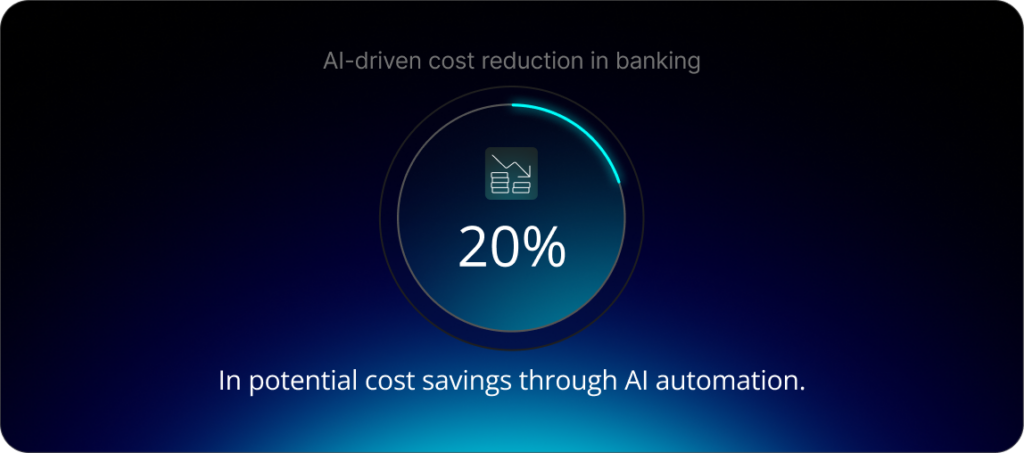
Persistently low rates and wage inflation have squeezed margins. Banks need to extract more value from existing resources. Unified data platforms expose process inefficiencies and, when coupled with automation, can materially reduce operating costs. Research suggests that AI adoption could deliver up to 20% in cost reductions (largely by automating routine tasks and augmenting internal workflows). Furthermore, automating routine activities frees staff for higher‑value work and helps protect margins.
Time‑to‑market and agility
Data fragmentation slows product development. Consolidating customer information into a real‑time repository lets incumbents iterate quickly and adjust decisions on the fly, matching fintech agility. With a single source of truth, teams can launch products faster, support quicker decisions at the right moment and tailor offers dynamically.
Compliance and risk management
Regulation grows ever more complex, consuming leadership attention. A Bank Policy Institute survey reports that 42% of C‑suite and 43% of board time is now devoted to regulatory and supervisory compliance matters. Standardizing definitions, consolidating data and automating lineage tracking can reduce the burden. Integrated datasets improve risk models and allow earlier fraud detection, while embedding regulatory rules into data pipelines makes reports traceable and timely.
Customer‑centric growth for data-driven banks
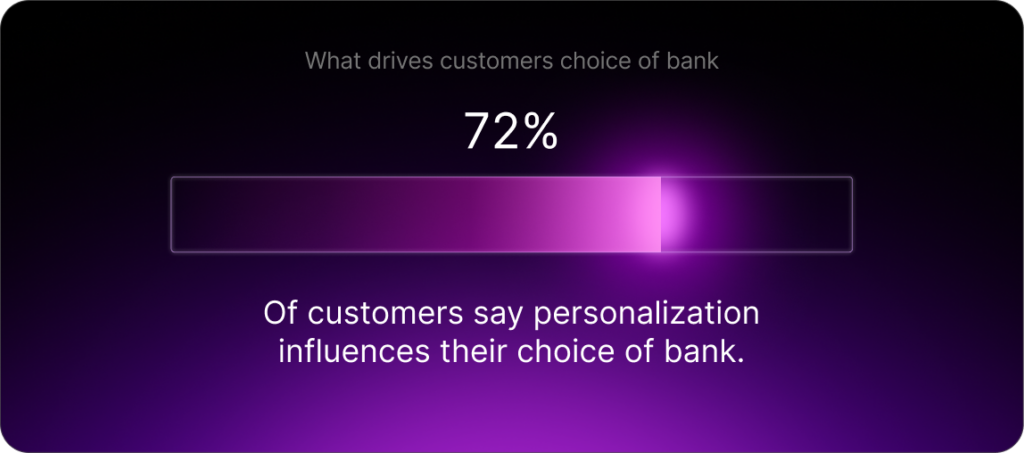
Customers now want Netflix‑like personalization from their banks. Accenture’s 2025 study shows that personalization influences the choice of bank for 72% of customers, and further studies find that personalization can lift revenue by 10–15%. Achieving this requires unified customer profiles and advanced analytics so that life events trigger relevant, timely offers across channels.
| Challenge | Data‑driven response | Evidence |
| Margin pressure | Identify inefficiencies through unified data; automate routine work to cut costs | AI adoption could deliver up to 20% cost reductions (largely by automating routine tasks and augmenting internal workflows) |
| Slow time‑to‑market | Consolidate data into a real‑time platform; enable rapid iteration and dynamic decisioning | Fragmented systems slow innovation; unified architectures enable real‑time insight |
| Compliance burden | Embed regulatory rules and reporting templates into a single data platform to automate compliance | Banks devote 42% of C‑suite and 43% of board time to compliance |
| Changing customer expectations | Use analytics to personalize interactions at scale; proactively identify needs | 72% of customers say personalization influences their choice of bank; data-driven banks can also drive a 10–15% revenue uplift |
What are the obstacles to becoming a leading data-driven bank?
Despite strong intent and abundant data, most banks remain far from becoming a true data-driven bank. The strategic case is clear, and leadership teams are investing accordingly. However, execution is slow, fragmented and often derailed by legacy realities. What looks like a technology problem is, in practice, a complex web of operational barriers that make data transformation difficult to scale.
Fragmented systems and siloed data
Years of product-led organizational structures and inorganic growth have left banks with a patchwork of legacy systems. As a result, critical customer data is often spread across dozens of databases that don’t communicate in real time. In one institution, customer information was split across 17 different systems, making even basic analysis a labor-intensive effort. This fragmentation limits banks’ ability to generate timely, accurate insights and to respond to changing market needs with agility.
Latency and real-time gaps
Many banks still rely on overnight batch processes to update their data, an approach misaligned with today’s demand for real-time responsiveness. Fraud detection systems, for example, often operate with 5–10 minute delays, leaving exploitable windows of vulnerability. Moving toward real-time data flows is not just a technical upgrade. Instead, it requires re-engineering long-standing processes and shifting entrenched cultural habits around data.
Data quality, trust and governance
Having data is not the same as trusting it. Inconsistent definitions, missing metadata and unclear lineage contribute to deep-seated reliability issues. A reported 80% of financial institutions have voiced concerns about the trustworthiness of their data, and 73% of executives say they struggle to turn it into usable insight. Without confidence in the underlying information, institutions hesitate to automate decisions or embed data deeply into frontline processes.
Cost and capability constraints
Building a modern data stack is resource-intensive. Banks must consolidate overlapping systems, invest in scalable infrastructure, and hire specialized talent in data engineering, analytics and AI. For many incumbents, these initiatives compete with other transformation priorities and carry significant perceived risk. It’s no surprise that 70% of financial firms say they lack the tools, skills or people needed to fully leverage their data assets.
How SBS enables data‑driven banking
SBS is a leading European banking software provider recognized by multiple industry analysts across key categories. SBS Data Platform and SBS AI are designed for regulated financial institutions to remove the blockers to data and AI adoption, such as fragmented data, governance constraints and lack of explainability. The Data Platform provides the governed data foundation, while SBS AI adds explainable AI, governed agents and controlled automation on top of that foundation.
These capabilities are directly aligned with the four strategic imperatives considered among the most pressing for banks:
- Margin pressure and efficiency
- Time‑to‑market and agility
- Compliance and risk management
- Customer‑centric growth
At the foundation of our solution is a unified data layer that ingests and brings together product data into a consistent foundation, extending to external sources through governed integrations depending on client needs and scope. For banks under pressure to contain costs and improve productivity, this consolidated view is a critical enabler. Data is structured across bronze, silver and gold layers to support cleaning, enrichment and business-ready data products. This reduces inconsistencies and makes data available within minutes, allowing teams to work from up-to-date information rather than relying on end-of-day batches.
The platform provides lineage and audit trails, quality controls and standards, and fine-grained permissions. SBS AI adds governance guardrails for prompts and governed access across ingested information entities, supporting compliant and auditable AI usage. To reduce the burden of compliance and internal reporting, the stack strengthens traceability and reconciliation back to source systems, improving auditability and reducing manual evidence gathering. Banks can create governed data products for reporting and regulatory aggregation use cases, based on product roadmaps and client priorities.
Deployment is flexible to fit regulatory and client constraints. The platform provides the scalability and resilience needed to support transformation without adding infrastructure complexity. SBS enables intelligent automation with explainable, governed agents that resolve queries, run analyses and trigger safe, controlled workflows inside core systems with the right access and approvals. The stack includes testers and monitors to evaluate and supervise AI behavior, supporting production use in regulated environments.
By linking data infrastructure directly to strategic outcomes, SBS helps banks modernize with purpose. Get in touch today and discover how SBS can help you harness the power of your bank’s data to create a formidable and lasting competitive advantage.
Questions and Answers
Why does data matter so much in today’s banking sector? + –
Data is the raw material for pricing, risk models and customer engagement. With margins under pressure and digital competitors on the rise, banks that turn data into insight can operate more efficiently, respond faster and deliver personalized experiences that build loyalty.
Can banks afford data and AI investments during economic uncertainty? + –
Yes. While budgets are tight, AI‑driven automation can trim costs by up to 20% and personalized offers can boost revenue by 10–15%, offsetting margin pressure and delivering near‑term returns.
What does “good” data governance look like? + –
It means having a single source of truth, clear data definitions, lineage tracking, quality rules and permissions. Strong governance lets banks trust their data and ensures that AI models are explainable and compliant.
How is SBS different from other data platforms? + –
SBS combines a governed Data Platform and a sovereign, explainable AI layer built specifically for regulated financial institutions. The SBS Data Platform provides unified, harmonized and documented banking data with lineage, governance and deployment flexibility across SaaS, private cloud or on-premise environments.
SBS AI adds explainable agents, safe tool-calling, monitoring and evaluator modules that allow banks to automate workflows and generate insights with full auditability and control. Unlike generic cloud data platforms or standalone AI tools, SBS is pre-integrated with SBS banking products and designed for sovereignty, regulatory compliance and production-grade AI deployment in core financial systems.