

• AI in asset finance has moved on from being a discussion to a present-day operational requirement.
• The US is navigating trade policy uncertainty and tariff impacts on vehicle mix and dealer margins.
• Europe’s automotive sector is managing a structural transition toward electric vehicles that is creating residual value volatility across the entire fleet.
The headline numbers for US asset and equipment finance in 2026 tell a confident story. Demand is at record levels, driven by three US Federal Reserve rate cuts in the final quarter of 2025 that eased borrowing costs and gave the asset finance industry momentum heading into the new year. AI-driven capital expenditure also provided a significant boost, particularly in technology and industrial equipment verticals.
However, the reality is more complicated, with a volatile US trade policy dominating the macroeconomic narrative in the first half of 2026. Tariffs have increased roughly eightfold over the past 12 months, the Equipment Leasing and Finance Foundation noted in its 2026 outlook. While the overall impact on the economy has been less severe than many forecasters feared, economic uncertainty has prompted lenders to rethink portfolio concentration, dealer exposure and how quickly they can respond when conditions shift.
The operational stakes are also rising on the auto floorplan. Cox Automotive data shows US new-vehicle days’ supply remained elevated at 90 days in December 2025. Fuller lots and longer dwell times mean more assets on floorplans for a longer period of time. This presents more opportunities for things to go wrong, as well as putting pressure on audit and risk processes that were designed for a different environment.
The lenders that will define this market over the next three to five years are the ones treating today’s strength as a window to build operational capability instead of a reason to stand still.
AI in asset finance: Moving from experiment to operational necessity
AI was a consistent theme that ran through every conversation at SBS Connect Dallas. As industry leaders shared their real-world experiences, it was clear that AI in asset finance has stopped being a discussion about the distant future and started being a present-day operational requirement. As Digital Dealer noted in an April report, the US auto finance lending environment has shifted from experimental adoption to essential operational infrastructure. Consumer demand for instant credit decisions and persistent market uncertainty have made AI essential for lenders who want to compete on speed and cost.
However, the most common trap for the asset finance industry in 2026 is the assumption that AI can autonomously manage the lending lifecycle once it is in place. Lenders pulling ahead are those that have treated AI as infrastructure, rather than a replacement for human judgment. By building data foundations, governance frameworks, and operational models, they have enabled AI to do what it does well at scale, while keeping people in the decisions that require context and accountability.
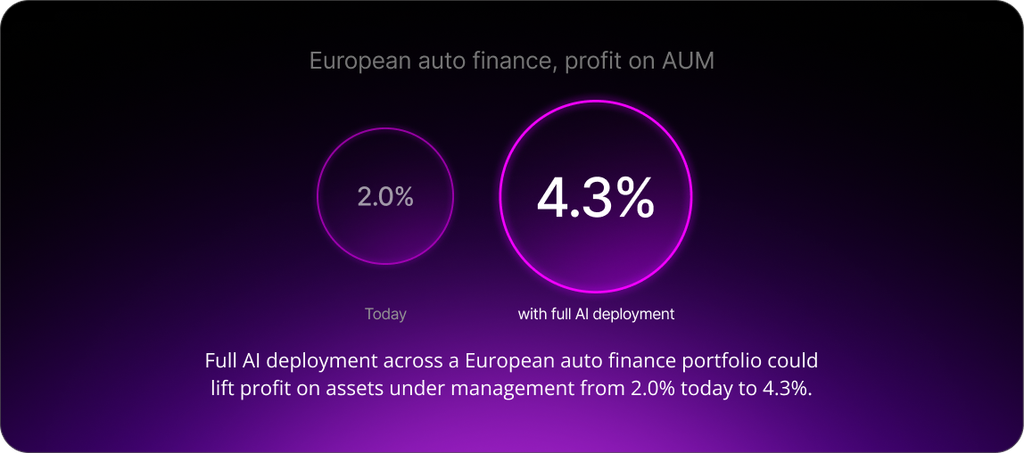
The picture is similar in Europe. At SBS Connect London in June, Corporate Value Associates presented modeling showing that full AI deployment across a European auto finance portfolio could move profit on assets under management from 2.0% to 4.3%. The research found that only a small number of players are making the effort required to get there. The early movers, on both sides of the Atlantic, are already building a cost and decisioning gap that compounds over time and becomes harder for others to close.
It is not the organizations with the most ambitious AI strategy that are winning. It is the ones with the strongest data foundations and the discipline to embed AI into the workflows where it can genuinely deliver.
Dealer floorplan financing: Where lending is won or lost
At SBS Connect Dallas, lenders said speed, simplicity, and the quality of the digital experience at every touchpoint are key to building a positive relationship with dealers. The front end of the lending relationship, from origination and onboarding through to day-to-day portfolio management, is where competitive differentiation is happening.
When discussing the dealer relationship at SBS Connect Dallas, participants focused on front-end dealer intelligence. This made it clear that the gap between what the best-performing lenders offer and what the rest of the market provides is measurable. Decisions can be better supported on both sides of the relationship through approval-to-book velocity, the quality of self-service digital tools, and lenders sharing data back into the dealer ecosystem.
This theme was also highlighted at SBS Connect London by James Baggott, founder of Clever Car Collection, an AI-native dealership built from the ground up by using artificial intelligence for everything from stock selection to customer communication. By connecting publicly available market data to AI-driven decision-making, Baggott’s dealership reduced average days to sell from the UK industry average of 60 days to 10. His message to lenders was that dealers moving at this pace will not accept finance partners who are not moving at the same speed. The financing process should not be the bottleneck in a transaction that can be completed in hours, Baggott said.
Whether the market is the US, UK, or Europe, dealers are raising their expectations of finance partners. Lenders that retain and grow dealer relationships will be those that prioritize the dealer experience as highly as they do their own servicing or auditing processes.

Risk, audit, and what your portfolio is not telling you
For years, audit was a compliance function that was scheduled at regular intervals to satisfy a regulatory or internal requirement. The combination of fuller lots, longer dwell times, and more complex asset classes is making that model inadequate for the risk environment lenders are operating in.
The shift toward hybrid auditing models, combining continuous digital monitoring with targeted physical inspection, is one of the most significant operational changes taking place across the asset finance industry. As SBS noted in its review of asset finance priorities for 2026, lenders that adopted hybrid auditing in 2025 reported earlier risk identification, more consistent controls, and improved confidence in the integrity of their floorplan portfolios. The case is not primarily about cost reduction, although that follows. It is about closing the gap between what lenders think they know about their portfolio and what the reality of their dealer networks is, in real time.
At SBS Connect Dallas, lenders took part in a workshop that put this in stark terms. When you audit a portfolio with the knowledge that some assets have moved off lot, some have flags that have been sitting unresolved for days, and some are simply not where the system says they are, the question is not whether your audit process works. It is whether it runs frequently enough, and with enough intelligence behind it to find issues before they become losses.
How does the US asset finance industry differ from Europe?
The conversations in Dallas and London covered more shared ground than most practitioners expected. AI adoption lag, legacy system integration challenges, and the dealer experience problem are present in both markets in similar forms. However, the nature of the external pressures, and the shape of the responses required, differs in important ways.
In the US, the primary external force in 2026 is trade policy uncertainty. The impact of tariff changes on input costs, vehicle mix, and dealer margins has introduced a form of portfolio risk that is structural rather than cyclical, and that requires a wider range of scenario planning and concentration monitoring than lenders have traditionally built for.
In Europe, the automotive sector is managing a structural transition toward electric vehicles that is creating residual value volatility across the entire fleet. At SBS Connect London, Corporate Value Associates described a market where OEM captives and independent lenders are effectively cross-subsidizing EV losses with internal combustion engine (ICE) vehicle margin. They also focused on how the expected tipping point in EV cost and performance around 2028 will reset the residual value model for both powertrains simultaneously. European lenders are also navigating regulatory infrastructure that, in some markets, is itself a bottleneck. Bank 11’s Jörn Everhardt described Germany’s requirement for paper-based car documents as a concrete regulatory constraint that prevents fully automated decisioning regardless of technology investment.
US lenders are beginning to encounter EV-specific portfolio questions, but the scale and immediacy of the European challenge is not yet present in North America. What is present, and growing, is the operational pressure to move faster, audit smarter, and build the kind of data infrastructure that turns portfolio intelligence from a periodic report into a continuous capability.
The direction is the same, but the starting point and the obstacles are different.
What the asset finance industry should build next
The asset and equipment finance industry is not short of ambition. What it is consistently short of is the operational infrastructure to translate ambition into outcomes at scale. The lenders that will define the next five years are now investing in the capabilities that make them faster, smarter, and more resilient when the market shifts: front-end dealer intelligence, AI-powered portfolio monitoring, and auditing models that give them a genuine real-time view of what they hold and where the risk is.
SBS supports floorplan and asset finance lenders across the full lifecycle, from origination and dealer management to portfolio risk and digital audit, through products including SBS Asset Finance, SBS Digital Audit, and the SBS AI Platform. To find out more about how SBS is helping lenders build for the road ahead, visit our website.
Q&A: Key questions on the future of asset finance
US asset finance lenders in 2026 are navigating a combination of record demand and structural uncertainty. Trade policy changes have affected input costs and portfolio concentration risk, while rising vehicle inventory days create additional operational pressure on floorplan portfolios. At the same time, the shift toward AI as an operational necessity, rather than a pilot capability, is separating lenders that have invested in data and process infrastructure from those who have not. According to the Equipment Leasing and Finance Foundation, the balance of risk in 2026 is tilted to the downside despite headline growth.