
- Digital payments are expected to capture 79% of all online spending and 53% of in-store purchases in the next five years.
- Many technical service providers have become financial institutions via EMI or PI institution to support their customer money flow. But it seems it is not enough. PSPs are increasingly applying for Credit Institution licenses.
- PI and EMI licenses limit the services that payment platforms can offer to customers.
- Credit Institution licenses and deposit protections enhance trust and customer confidence.
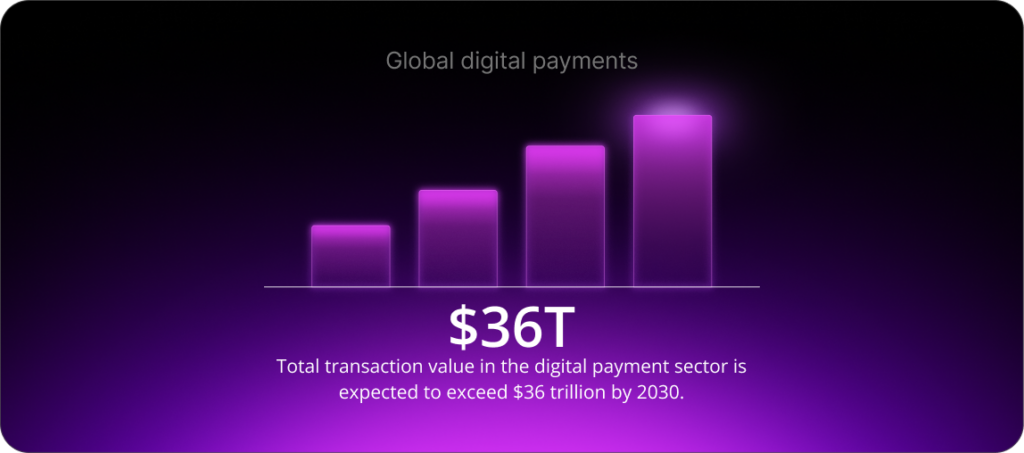
Payment service providers (PSPs) are increasingly giving traditional banks a run for their money, as they move beyond their core business model of enabling fast, flexible transactions worldwide. The trend points to a broader shift among PSP players, including payment giants PayPal, Stripe and Adyen, toward becoming licensed financial institutions, allowing them to accept deposits, provide credit, and offer other traditional banking services. The total transaction value in the digital payment sector continues to surge, and it is expected to reach more than $36 trillion by 2030, according to Statista. Despite impressive growth, PSPs are recognizing that the fundamentals of their business model are restricted due to high transaction costs coming from the reliance on sponsor banks.
According to Worldpay’s Global Payments Report, fintechs and embedded finance are likely to shape payment trends over the next five years, with digital payments expected to capture 79% of all online spending and 53% of in-store purchases. At the same time, more than $28 trillion will be spent via digital wallets globally by 2030, both online and in-store, Worldpay says in the report.
As a result, PSPs are increasingly seeking to switch their Payment Institution (PI) or Electronic Money Institution (EMI) licenses to credit institutions licenses, to capitalize on the surge in digital payments and offer customers a “one-stop shop” service. This will allow them to reduce their reliance on third-parties, lower funding costs by raising deposits, and expand their revenue streams though lending.
What are the strategic drivers for seeking a credit institution license?
If PSPs plan to expand beyond transaction processing into lending, they need to move from PI or EMI licenses to a credit institution license. The trend of entering the credit space makes sense: PSPs also sit at the heart of merchant cash flows, providing merchant payment acceptance tools, such as online checkout, payment pages and in-store terminals. They collect card payments on behalf of merchants and settle the funds to the merchant later, often after a delay linked to card scheme settlement timing.
This means that PSPs sit within the transaction flow, so they see the merchant’s real activity and have better data than a traditional bank, which only sees a bulk transfer arriving. However, under a PI license, a PSP can collect and transfer money on behalf of others but is prevented from holding it like a bank. This essentially means that the PSP is only a facilitator or “pass-through” actor.
On the other hand, EMI licenses allow PSPs to hold customer funds in e-money accounts. Like the PI, this license does not allow to make money through providing credit, loans, overdrafts and broader banking services.
In contrast, a credit institution license offers a vastly different operating model that allows diversified revenue streams through activities such as deposit-taking and lending, with both fee and interest income. In turn, the diversified revenue supports scale through balance-sheet growth and deeper integration with financial systems.
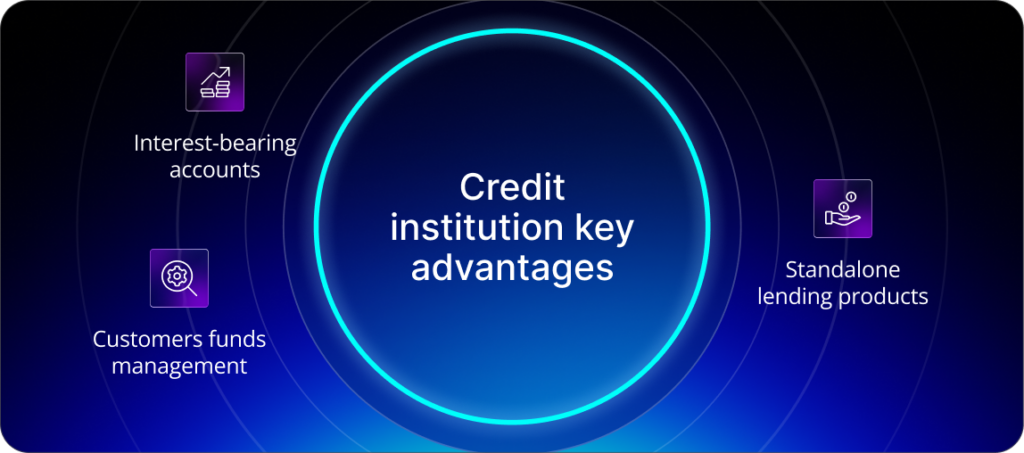
This means that banks can offer numerous services and protections that PI and EMI licensed institutions cannot, such as:
- Managing customers’ money, including investing it or using it to issue loans to other customers at a profit.
- Providing interest-bearing accounts.
- Offering standalone lending products, such as consumer loans, and cashflow financing to merchants.
Banks are also able to apply for additional licenses for individual regulated activities, such as investment and asset management services. Finally, there are reputational advantages stemming from enhanced trust and customer confidence that come with regulatory deposit protection.
For large PSPs, relying on partner banks can restrict product design, increase funding costs and introduce operational dependencies that limit flexibility as volumes grow. More importantly, regulated banks offer customers stronger protections, clearer deposit safeguards and greater regulatory oversight, significant factors for PSPs as they now hold larger balances and play a more prominent role in consumers’ financial lives. Meanwhile, a banking license offers greater control over the payment stack itself. For example, PayPal’s proposed PayPal Bank would allow the company to pursue more direct access to payment rails and card networks, supporting efficiency gains and tighter integration across payments, deposits and lending.
How payment services are transitioning toward credit institution licenses
For the world’s biggest PSPs, the shift to banking licenses is less about becoming a traditional bank and more about removing structural constraints that limit scale. Rather than relying on numerous partner banks, licenses and regional workarounds, the biggest players are seeking regulated models that give them greater control over funding, infrastructure and product design. Infrastructure control is a key driver for PSPs switching to banking licenses. Historically, PSPs used third parties to connect to the “payment highways”, such as card networks and processing infrastructure, because that capability is expensive and requires scale.
However, once a PSP becomes large enough, it can justify building its own processing and acquiring infrastructure because fixed costs have become affordable at higher volumes. The PSP no longer bears the cost of intermediaries and the transactional costs drop. While each market and its regulatory requirements differ, some PSPs are applying for full banking licenses while others are opting for specialised charters. However, their aim is the same: to integrate payments, deposits and lending under a unified regulatory framework.
Here, we explore how PayPal, Stripe and Adyen are approaching their banking license strategies.
PayPal: From a payments powerhouse to a proposed bank
In December 2025, PayPal submitted applications to launch PayPal Bank, a Utah-chartered industrial loan company, known as an ILC. The application aims to expand its role in financing small businesses. A banking license would change PayPal’s model by allowing it to fund lending activities directly through customer deposits, operate under a single regulated banking entity and reduce its reliance on third-party banking partners.
Since launching its merchant lending program in 2013, PayPal has provided more than $30 billion in financing to over 420,000 businesses. By obtaining a bank charter, PayPal can provide these loans more efficiently “while reducing reliance on third parties and strengthening PayPal’s business,” the company’s CEO, Alex Chriss, said.
“Establishing PayPal Bank will strengthen our business and improve our efficiency, enabling us to better support small business growth,” Chriss added.
In addition to small business lending solutions, PayPal Bank also plans to offer interest-bearing savings accounts to customers and would seek direct membership in the US with card networks to complement processing and settlement activities through existing banking relationships, Chriss noted.
Stripe: Seeking expansion through a banking charter
Stripe has grown into a global financial payments giant since being founded by Patrick and John Collison in 2010, who were seeking to simplify online payment processing. In 2024 alone, it processed $1.4 trillion in total payment volume, up 38% from the prior year and equivalent to around 1.3% of global gross domestic product, the financial services platform said in its 2024 annual letter to the Stripe community.
In June 2025, Stripe’s application for a Merchant Acquirer Limited Purpose Bank (MALPB) charter was approved by the US state of Georgia, giving the financial infrastructure platform direct access to card networks. The MALPB charter gives Stripe direct membership in the US with Visa and Mastercard, allowing it to process payments without a sponsoring bank, according to a report by PYMNTS.
However, the MALPB charter does not allow Stripe to engage in general banking activities, the Independent Community Bankers of America (ICBA) said about to Stripe’s MALPB charter approval.
“Under Georgia law, MALPBs are limited in their activity, which is designed to facilitate their merchant acquiring business,” the national trade association added. “MALPB charters are prohibited from engaging in general banking activities, may not solicit or accept deposits from the general public and may not sponsor ATMs or issue payment cards.”
However, the MALPB charter aligns with Stripe’s broader strategy of removing intermediaries from the payment chain, giving it direct access to card networks without taking on the full obligations of a credit institution.
Adyen: An early mover in bank licenses
Dutch financial technology platform Adyen was an early mover in the trend of PSPs applying for banking licenses. In 2017, the company received its first banking license in the EU. By 2023, had also been granted banking licenses in the UK and the US.
“Before this, we did what many other payment service providers do: we used sponsor banks to facilitate money movement and provide compliance oversight,” Adyen says on its website.
“By owning the whole process, there’s more opportunity to design solutions that impact each part of the payment journey. This includes the multi-channel gateway, risk management, processing, global acquiring and settlement,” it adds.
In its financial results for the full-year to December 31, 2025, Adyen reported net revenue of €2.36 billion, up 18% year over year, while processed volume jumped 21% on an annual basis to reach €1.39 trillion.
Founded in 2006, Adyen has acquiring licenses in a range of countries, including Japan, the UAE, Malaysia, Puerto Rico, Singapore, Australia and New Zealand. It also accepts payments in nearly 100 countries. Meanwhile, the regulatory paths differ by market. In the US, a recent surge in bank charter applications highlights how fintechs are seeking access to deposits and payment rails under federal oversight.
In Europe, where the European Central Bank governs banking licenses under the Single Supervisory Mechanism, the bar remains high, highlighting the differences between payment providers and fully authorized banks. As digital wallets and fintech platforms continue to scale, the limitations of operating solely under PI or EMI licenses have become more apparent, particularly in funding, trust and control over infrastructure.
Against this backdrop, the strategies of PayPal, Stripe and Adyen show different routes toward the same objective, not only to expand their product portfolios and bottom lines, but also to reposition themselves closer to the core of the financial system.
For more expert content on industry outlooks and innovation, subscribe to our newsletter or visit our Insights page.
Questions and Answers
It signals a structural shift in the financial ecosystem, increasing pressure on banks to accelerate their digital transformations as more PSPs seek banking licenses. Competition will intensify between traditional banks and digital-first challengers, as they offer customers a “one-stop shop” of financial services. Some banks could also experience reduced fee income from payment processing and settlement services, as third-party collaborations reduce.