

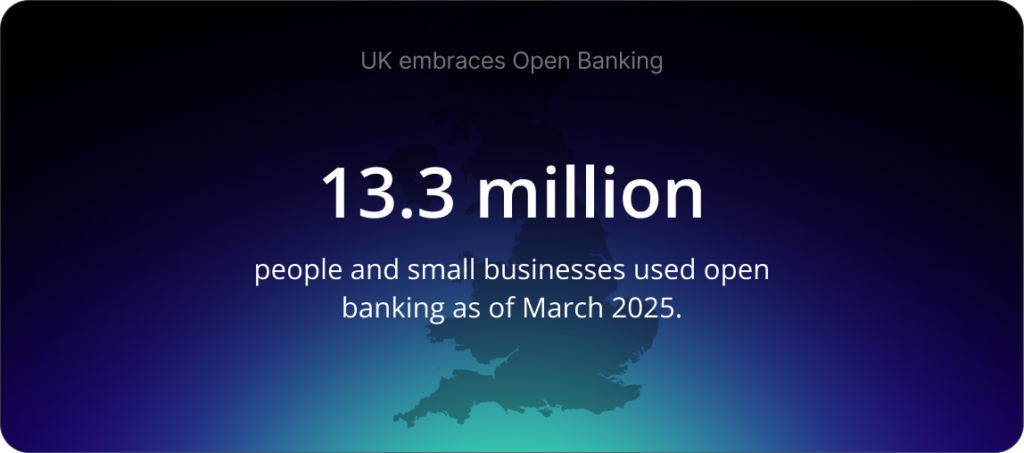
- 13.3 million UK consumers and small businesses used Open Banking as of March 2025.
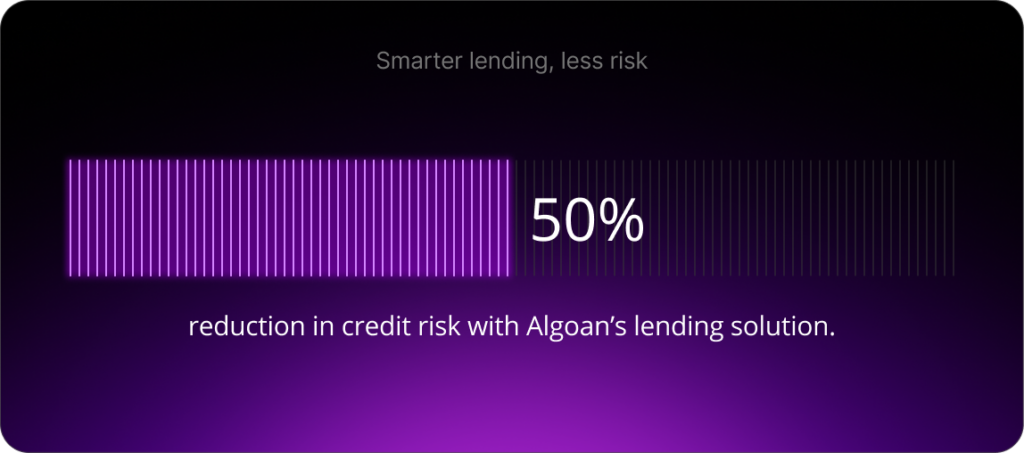
- Lenders using open banking have reduced credit risk by up to 50% and increased loan production by 40%.
- The UK Open Banking ecosystem is generating over £4 billion in economic value and supporting 5,000+ digital jobs.
Open banking has been a staple of the UK financial services landscape for some years now – ever since 2018, when it was introduced under PSD2 as a regulatory requirement and implemented by the Competition and Markets Authority (CMA). The aim of open banking was, and remains, simple: to democratize money management by allowing secure data sharing through open bank APIs. It’s this simplicity, coupled with the technology to enable it, that has allowed open banking to become such a resounding success.
As of July last year, 10 million consumers and small businesses were regularly benefiting from using open banking technology, per Open Banking Limited, and that number had risen to 13.3 million as of March 2025. Furthermore, the UK open banking ecosystem is fueling over £4 billion in economic boost, supporting 5,000-plus digital jobs and contributing to a potential £28 billion GDP uplift.
However, despite how far open banking has come since 2018, it remains an underused tool for many UK banks and financial institutions, especially when it comes to generating growth. In this article, we explore three key areas where we believe banks are underusing open banking, and how they can take advantage of it to develop new opportunities.
Friction-free onboarding
Slow, cumbersome onboarding has long been a sticking point in banking — especially for larger, traditional players. A recent global study of over 450 C-level executives found that more than two-thirds have lost clients due to inefficient onboarding. And the problem is only getting worse. Today’s customers, especially younger ones, expect simple, seamless digital experiences — and they’re quick to abandon applications that don’t meet that standard.
Open banking can help to fix this. By enabling secure, real-time data sharing, it removes many of the obstacles that frustrate both customers and banks. Applicants no longer need to dig up old documents or wait days for verification. Banks don’t need to rely on incomplete information or slow manual checks.
Instead, onboarding becomes:
- Faster, thanks to instant data verification
- Simpler, with pre-filled forms and fewer steps
- Smarter, with the ability to tailor offers right from the start
The result is a smoother experience for customers — and for financial institutions, better data, faster conversion and stronger customer relationships from day one.
Case study: Solving Nationwide’s drop-off dilemma with open banking
In 2022, leading UK building society Nationwide made a worrying discovery. Roughly 8% of new savings accounts were never funded. Not because of fraud or rejection, but simple forgetfulness. Customers were creating accounts, but not depositing money into them. They realized that this was a UX problem: the funding step was disconnected from the signup flow, creating unnecessary friction at a critical moment. And they found a novel solution.
Rather than relying on reminders or better email workflows, Nationwide embedded an open banking-powered payment initiation step directly into the account confirmation screen. This allowed customers to fund their accounts instantly, during the onboarding journey itself. As a result, the building society quickly saw a significant reduction in unfunded accounts and a smoother, more intuitive user experience.
Real-time credit
To this day, many lending services are slow and opaque, creating headaches for borrowers and lenders alike. Depending on the financial institution and specific circumstances, credit can take weeks to be approved, and even then, many customers are unsure as to the specific details of the loan. Per a 2022 financial literacy report, 64% of people in the UK have taken out a mortgage or personal loan without fully understanding how it works.
A combination of artificial intelligence and open banking can rapidly increase the approval time of this process, while remaining safe, secure and responsible for borrowers and lenders. With direct access to customers’ financial data, thanks to open banking, lenders can use automated tools and AI to assess credit risk faster and more accurately. This reduces delays caused by manual underwriting or waiting for third-party credit reports.
Case study: Algoan transforms credit decisioning with open banking
France-based credit experts Algoan have been helping lenders to modernize their credit assessments by harnessing the power of open banking since they launched back in 2018. Instead of relying solely on outdated or incomplete credit bureau data, Algoan’s API-based solution integrates real-time bank transaction data to provide a fuller, more accurate picture of an applicant’s financial health, including income stability, spending habits and indebtedness.
By embedding Algoan’s open banking–driven credit scoring into their workflows, lenders can make faster, fairer and more data-driven decisions. The result is a fully digital lending journey with improved risk management and wider access to credit.
Lenders using Algoan’s solution have seen up to a 50% reduction in credit risk, a 40% increase in loan production, and significantly lower processing costs. This paves the way for smarter, more inclusive lending that benefits both providers and consumers.
Maximizing lifetime value
With increased customer acquisition costs and tighter competition from fintechs and neobanks, traditional banking players need to focus on maximizing the lifetime value of their clients more now than ever before. In fact, research shows that just 23% of banks’ customers are using more than one of their products, highlighting a massive opportunity lost. Customer retention, cross-selling and deepening client engagement must be central to banks’ strategies going forward, and open banking can play an important role in enabling that.
By accessing a customer’s real-time financial data – including income, spending habits and existing financial products held elsewhere – banks can offer tailored products at exactly the right moment. These might include proactive financial insights like specific budgeting advice and identifying the right savings opportunities, and competitive benchmarking and product switching.
These types of hyper-personnalized recommendations and insights can help customers to better manage their money while providing banks with new revenue streams and building customer trust.
Case study: Boosting retention through smarter segmentation
One UK lender found that its traditional approach to customer retention wasn’t delivering results. Its segmentation model relied on static, rules-based assumptions to predict lifetime value and target offers. But these assumptions didn’t reflect the speed and complexity of modern financial behaviour.
So the lender turned to open banking.
By replacing its legacy model with a gradient-boosting machine learning model trained on real-time open banking data, the company was able to segment customers with much greater accuracy. Instead of using broad demographic proxies, it could now use up-to-date, granular behavioural indicators. As a result, the lender saw a 43% reduction in out-of-time prediction error, and a 3x lift in product uptake among the most relevant customer segment, proving that recency and detail matter – not just at acquisition, but throughout the entire customer lifecycle.
Crucially, this shift didn’t just improve targeting, it improved continuity. With a more accurate picture of each customer’s evolving needs, the lender could embed its services more meaningfully in their daily financial lives. The result? Stronger engagement, longer relationships and higher lifetime value.
How SBS can help
When it comes to growth, open banking and its applications provide financial institutions with plenty of exciting opportunities. Whether it’s streamlining onboarding processes, allowing for real-time credit or helping to create longer, more engaging bonds with customers, open banking is a tool that banks simply cannot afford to ignore.
SBS can help your bank to leverage these opportunities with our SBS Open Banking platform. Our solution – recognized as an industry-leader by OMDIA – will enable you to unlock a customizable platform with seamless integration, unleashing a diverse set of cutting-edge use cases.
We also bring the best-in-breed partners – such as Algoan, for high-level credit insights powered by open banking – to help you go further. Whether you’re building new embedded or platform banking experiences, or staying compliant with evolving regulations, we provide the tools and partnerships to support your success.
Get in contact today, and find out how to achieve significant, future-proof growth thanks to open banking.